Kids’ magnetic building tiles vary most in piece count, specialty parts, and how much room they leave for open-ended building. I’d choose PicassoTiles 100-Piece Magnetic Building Tiles as the best overall starting point for families who want a broadly useful set from an established product line. For vehicle-led play, Cossy’s 120-piece set with two cars adds a clear play feature, while Soyee’s 32-piece set is a more manageable entry point for younger or first-time builders. Larger counts can offer more scope, but cars, roads, wheels, and themed pieces may matter more than the headline number. Read on for how the options differ and which tradeoffs fit your child’s play style.

Turn the school run and nap time into listening time
- Thousands of audiobooks, podcasts and originals
- Listen on your phone, tablet or Echo — also offline
- Cancel anytime
Complete the kit


Key Takeaways
- PicassoTiles’ 100-piece set leads as the most balanced general-purpose pick, while its 60-piece clear set offers a smaller, simpler starting footprint.
- Soyee’s 32-piece set is the most approachable for trying magnetic construction without beginning with a large assortment.
- Cossy, Dopyye, Ryoichi, and Anbalulu’s 100-piece set include two cars, making vehicle play a more visible part of the build than in basic tile assortments.
- Goodtiles’ 38-piece road set and GobiDex’s princess castle set prioritize themed play; they are more focused choices than open-ended tile sets.
- High piece counts do not tell the whole story: the mix of shapes and specialty parts determines whether a set supports varied structures or mainly repeats one play idea.


| kids magnetic building tile | Brand | Material | Piece count | Model |
|---|---|---|---|---|
| Mruikeny Magnetic Building Til | Mruikeny | ABS plastic | — | Item153 |
| Anbalulu Magnetic Building Til | Anbalulu | High-transparency plastic | 134 | AN-0006 |
| FNJO 100-Piece Magnetic Tiles | FNJO | ABS plastic | 100 | FN-100+ |
| PicassoTiles 60-Piece Magnetic | PicassoTiles | Plastic | 60 | PT60 |
| Cossy 120-Piece Magnetic Tiles | Cossy | ABS plastic | 120 | T-MT-120-9X7G |
| Coodoo 60-Piece Magnetic Build | Coodoo | Plastic | 60 | COODOO-D |
| Anbalulu Magnetic Tiles Buildi | Anbalulu | ABS plastic | 100 | Anba-63 |
| Jasonwell 100-Piece Magnetic T | Jasonwell | BPA-free, lead-free material | 100 | JX-MBB-CJ100 |
| Dopyye 132-Piece Magnetic Buil | Dopyye | ABS plastic | 132 | Doy-132 |
| Ryoichi 138-Piece Magnetic Til | Ryoichi | ABS plastic | 138 | Ryo-138 |
| Soyee Magnetic Tiles Building | Soyee | — | 32 | — |
| PicassoTiles 100-Piece Magneti | PicassoTiles | Plastic | 100 | PT100 |
| FNJO Magnetic Building Tiles | FNJO | ABS plastic | 110 | FN-110 |
| Goodtiles Magnetic Road Tiles | Goodtiles | Food-grade ABS plastic | 38 | Goodtiles-E |
| GobiDex 100-Piece Princess Cas | GobiDex | ABS | 100 | — |
More Details on Our Top Picks
Mruikeny Magnetic Building Tiles for Kids, STEM Construction Set
Mruikeny’s flexible, cross-compatible tile set suits families who want children to make their own structures rather than follow a fixed theme. The idea booklet can help spark builds such as towers, vehicles, animals, and castles, while smooth edges and sturdy rivets support everyday handling. Unlike the clearly counted Anbalulu 134-Piece set or Cossy’s 120-piece assortment, Mruikeny does not state how many pieces are included, so buyers cannot readily judge its building capacity or compare value by set size. Compatibility with other magnetic tiles is useful for expanding an existing collection, though the description does not identify specific brands or tile dimensions. I’d choose it for creative play with an established tile stash, but skip it if a known piece count is central to the purchase.
Pros:- Idea booklet offers starting points for varied builds, including towers, vehicles, animals, and castles.
- Smooth edges and sturdy rivets are designed for child-friendly handling.
- Compatible with other magnetic building tiles, allowing a collection to grow.
- Open-ended shapes support creative construction rather than a single themed play pattern.
Cons:- Piece count is not specified, making capacity difficult to compare with Anbalulu or Cossy.
- Compatibility is described broadly without naming brands or tile dimensions.
- Small pieces mean the stated age guidance does not suit children under 3 without adult supervision.
Best for: Families with existing compatible magnetic tiles who want an idea booklet and room for open-ended building.
Not ideal for: Buyers choosing by set size or planning a first collection who need a stated piece count and clearer compatibility details.
- Brand:Mruikeny
- Model:Item153
- Material:ABS plastic
- Recommended age:3 years and up
- Set type:Colorful magnetic tiles
- Included component:Instruction manual
- Compatibility:Compatible with other magnetic building tiles
Our verdict“Choose Mruikeny for open-ended builds and possible collection expansion, but pick a counted set if you need predictable capacity.”
Anbalulu Magnetic Building Tiles Set, 134 Pieces
Anbalulu’s 134-piece assortment is the strongest pick here for children who want enough parts to build together or try several structures without constantly taking one apart. The 132 geometric tiles are joined by two magnetic cars, an idea book, and a storage container, giving play a rolling-build option and a clear place to put pieces away. Compared with PicassoTiles’ 60-piece set, Anbalulu offers substantially more components and cars; unlike Cossy’s 120-piece set, it also lists a storage container. Its high-transparency plastic and embedded neodymium magnets are described as supporting construction, while CPC testing is specified in the product data. The tradeoff is that tile and container dimensions are absent, so fit and storage footprint are hard to predict. I’d favor it for shared play, not for buyers who need exact sizing information.
Pros:- 134 pieces include 132 geometric tiles and two magnetic cars for varied builds.
- Storage container gives the set a dedicated place for cleanup.
- Idea book can help children get started with construction projects.
- Product data specifies CPC testing and smooth-edged, high-transparency plastic.
Cons:- Tile and storage container dimensions are not specified.
- The set is recommended for ages 3 and up, so it is not intended for younger children.
- Its larger assortment may be more than needed for families seeking a compact starter set like PicassoTiles’ 60-piece option.
Best for: Families with multiple young builders who want a high-piece-count set with cars, an idea book, and included storage.
Not ideal for: Buyers with a specific shelf or play surface in mind, since tile and container dimensions are not provided.
- Brand:Anbalulu
- Model:AN-0006
- Piece count:134
- Contents:132 magnetic tiles, 2 magnetic cars, idea book, storage container
- Recommended age:3 years and up
- Material:High-transparency plastic
- Magnet type:Neodymium
- Safety testing:CPC tested
Our verdict“Pick Anbalulu for shared building and a substantial, storage-equipped assortment; skip it if you need exact dimensions or a small starter set.”
FNJO 100-Piece Magnetic Tiles STEM Building Set for Kids
FNJO’s 100-piece set bridges flat pattern-making and 3D construction: it includes 94 magnetic shapes, two car bases, four click-in pieces, and an idea book. That mix gives children more ways to vary a build than PicassoTiles’ simpler 60-piece collection, while its same-size cross-brand compatibility can make it easier to add familiar tiles. Smooth surfaces and rounded edges are a practical fit for small hands, and ABS plastic is the specified material. One distinction buyers should notice is that four click-in pieces are non-magnetic; they add a different building element, but they will not connect like the tiles. The set is also smaller than Anbalulu’s 134-piece option, which may suit a focused play area but gives less total material for large shared structures. I’d choose FNJO for varied build formats, not for an all-magnetic set.
Pros:- 94 magnetic shapes support both 2D patterns and 3D structures.
- Two car bases and an idea book add building options and project prompts.
- Compatible with same-size magnetic tiles from other brands.
- ABS plastic with smooth surfaces and rounded edges is designed for child-friendly handling.
Cons:- Four included click-in pieces are non-magnetic, unlike the magnetic shapes.
- Its 100-piece count is lower than Anbalulu’s 134-piece set for larger group projects.
- Cross-brand fit is specified only for tiles of the same size.
Best for: Families seeking a mid-sized set for both flat patterns and 3D builds, especially those adding same-size tiles from other brands.
Not ideal for: Buyers who want every included construction piece to connect magnetically or need the largest set for group builds.
- Brand:FNJO
- Model:FN-100+
- Piece count:100
- Included pieces:94 basic shapes, 2 car bases, 4 non-magnetic click-ins
- Material:ABS plastic
- Included component:Idea book
- Recommended age:3 years and up
- Compatibility:Same-size magnetic tiles from other brands
Our verdict“Choose FNJO for mixed 2D and 3D building with compatible expansion, but look elsewhere if you want every piece to be magnetic.”
PicassoTiles 60-Piece Magnetic Building Tiles, Clear
PicassoTiles’ 60-piece set is the most straightforward starting point in this group for families who want a smaller tile collection rather than a large assortment of shapes and extras. Its clear, BPA-free plastic tiles are made for hands-on 3D construction, with smooth edges and a size intended for small hands. Compared with Anbalulu’s 134-piece set or Cossy’s 120-piece set with car bases, this one has fewer pieces and no vehicles, so it is less suited to sprawling builds or play centered on rolling creations. Its advantage is a more focused entry into magnetic-tile play, plus compatibility with full-size PicassoTiles sets for brand-specific expansion. That compatibility is narrower than FNJO’s stated same-size cross-brand fit. I’d pick it for a compact first collection or an existing PicassoTiles setup, but not for buyers seeking broad brand mixing.
Pros:- A 60-piece count offers a more compact entry than Anbalulu’s 134-piece set.
- Clear, BPA-free plastic tiles have smooth edges and are designed for small hands.
- Connects with full-size PicassoTiles sets for brand-specific expansion.
- Supports solo or group indoor play and 3D STEM construction.
Cons:- Fewer pieces than Anbalulu’s 134-piece and Cossy’s 120-piece sets limit large builds.
- No car bases or other themed components are listed.
- Compatibility is specified for full-size PicassoTiles sets rather than broadly across brands.
Best for: Families starting with a manageable number of tiles or adding to a full-size PicassoTiles collection.
Not ideal for: Children who want a large shared build or car-based projects, and buyers seeking specified compatibility across multiple brands.
- Brand:PicassoTiles
- Model:PT60
- Piece count:60
- Recommended age:3 years and up
- Material:Plastic
- Material safety:BPA-free
- Color:Clear
- Compatibility:Full-size PicassoTiles sets
- Item dimensions:2.56 x 11.02 x 18.9 inches
Our verdict“Choose PicassoTiles for a focused starter collection or compatible brand expansion, but pick a larger set for more ambitious group builds.”
Cossy 120-Piece Magnetic Tiles Building Set with 2 Cars
Cossy’s 120-piece set stands out for its specified shape mix: squares, windows, three triangle sizes, rectangles, and two car bases. That breakdown helps buyers see what they are getting before choosing, and it gives children more options for roofs, walls, and vehicle-based builds than PicassoTiles’ 60-piece clear set. Compared with Anbalulu’s 134-piece assortment, Cossy has fewer total pieces but lists a detailed tile breakdown and says it works with other brands. Rounded-corner ABS tiles are designed for durable, child-friendly construction, and the set’s listed dimensions give families a sense of its packaged footprint. The main limitation is the age guidance of 3 and up; there is no specified safety testing or storage container in the supplied details. I’d choose it for varied geometric building, not for buyers prioritizing included storage or documented testing.
Pros:- 120 pieces include squares, windows, three triangle sizes, rectangles, and two car bases.
- Detailed tile breakdown makes the shape assortment easier to compare with other sets.
- ABS plastic tiles have rounded corners and are described as durable.
- Compatible with other brands, offering room to expand beyond the set.
Cons:- The set is recommended for ages 3 and up.
- No storage container is listed among the included components.
- The product details do not specify safety testing.
Best for: Families who want a varied mix of geometric tiles and two car bases, with shape counts and overall dimensions stated.
Not ideal for: Buyers who need an included storage container or want safety testing details specified in the product information.
- Brand:Cossy
- Model:T-MT-120-9X7G
- Piece count:120
- Tile breakdown:20 squares, 20 windows, 30 small triangles, 24 medium triangles, 6 tall triangles, 12 rectangles
- Included components:Magnetic tiles, 2 car bases, instruction manual
- Material:ABS plastic
- Recommended age:3 years and up
- Dimensions:13.23 x 9.57 x 3.9 inches
- Compatibility:Compatible with other brands
Our verdict“Pick Cossy for a clearly documented shape mix and car builds, but choose Anbalulu if an included storage container matters more.”
Coodoo 60-Piece Magnetic Building Tiles Set
Specialty pieces over sheer quantity give this 60-piece Coodoo set a clear purpose: six balcony tiles and two awnings add architectural details that standard square-and-triangle assortments may lack. That makes it a better fit for children who like building houses and castles than the Anbalulu 100-piece set, which puts more emphasis on a larger assortment and two cars. The colorful plastic tiles also support open-ended shape and color play, while the included storage bag helps keep a modest-sized set together between sessions.
The tradeoff is capacity: 60 pieces leave less room for sprawling structures or several children to build at once. I’d choose Coodoo for detailed small builds, not for maximum construction scale. Its age guidance starts at 36 months, so it is not intended for children under three.
Pros:- Six balcony pieces and two awnings add architectural details for house and castle builds.
- Colorful tiles support open-ended shape, color, and sensory play.
- Storage bag helps with organizing and carrying the set.
- Plastic construction is described as durable.
Cons:- The 60-piece assortment offers less building capacity than the 100-piece Anbalulu and Jasonwell sets.
- No cars or other moving-play components are included.
- Recommended for ages 36 months and up, not younger children.
Best for: Families looking for a manageable starter set with balcony and awning pieces for house, castle, and other architectural builds.
Not ideal for: Children who want large, elaborate structures or vehicle-focused play; the 60-piece count is smaller than the Anbalulu and Jasonwell 100-piece sets.
- Brand:Coodoo
- Model:COODOO-D
- Piece count:60
- Material:Plastic
- Special pieces:6 balcony pieces and 2 awning pieces
- Storage:Storage bag
- Recommended age:36 months–14 years
- Target audience:Children, unisex
Our verdict“Choose Coodoo if architectural details matter more than a large piece count or included vehicles.”
Anbalulu Magnetic Tiles Building Set, 100 Pieces with 2 Cars
The Anbalulu set balances a 100-piece tile assortment with two cars, giving kids a way to shift between building structures and rolling their creations around. Compared with the Coodoo 60-piece set, it offers more pieces and vehicle play, though Coodoo’s balconies and awnings make it more specifically suited to detailed houses and castles. Anbalulu’s ABS plastic tiles have rounded edges and smooth surfaces, and the product description says the magnets are securely sealed—useful details for a set meant for regular hands-on construction.
This is a practical middle ground for home, school, or daycare play, but the two cars do not make it a dedicated road or vehicle set. The supplied details also do not list a storage bag, unlike Coodoo and the Dopyye 132-piece set. Its age range begins at 36 months, so it is not meant for children under three.
Pros:- 100 pieces provide more building capacity than Coodoo’s 60-piece set.
- Two included cars add rolling play to tile construction.
- ABS plastic tiles have rounded edges and smooth surfaces.
- Product description specifies securely sealed magnets.
Cons:- No storage bag is listed among the included components.
- The two cars add play variety but do not replace a dedicated road-tile assortment.
- Recommended age begins at 36 months, so it is not intended for children under three.
Best for: Families or group settings wanting a 100-piece magnetic tile set that includes two cars for mixed building and rolling play.
Not ideal for: Buyers who want a storage bag, architectural specialty pieces, or a larger assortment; consider Coodoo for balconies and awnings or Dopyye for more pieces and listed storage.
- Brand:Anbalulu
- Model:Anba-63
- Piece count:100
- Included cars:2
- Material:ABS plastic
- Color:Multicolored
- Recommended age:36 months to 10 years
- Item dimensions:10.6 x 8.16 x 3 inches
- Item weight:5.2 pounds
Our verdict“Pick Anbalulu for a balanced 100-piece set with two cars, provided you do not need a listed storage bag.”
Jasonwell 100-Piece Magnetic Tiles Building Set with Rotatable Ferris Wheel
A rotatable Ferris wheel gives this Jasonwell set a play feature the other 100-piece option here does not offer. Alongside assorted shapes, it creates a reason to build structures with movement and can help keep construction play going after the tiles are assembled. An idea booklet adds prompts for children who want a starting point, while the stated compatibility with similar-size magnetic tiles may let families combine it with an existing collection. Compared with the Anbalulu 100-piece set, Jasonwell favors a moving centerpiece and build inspiration rather than two included cars.
The tradeoff is that the product data does not specify the tile dimensions clearly: the listed dimensions are 0.39 × 0.39 × 0.39 inches, which may not describe individual tiles. That makes size comparisons harder. The set is listed for ages three and up and weighs 1.53 kg, so it is less appealing if a buyer wants a clearly documented compact set.
Pros:- Rotatable Ferris wheel adds movement beyond static structures.
- 100-piece assortment supports varied building projects.
- Idea booklet offers prompts for getting started.
- Materials are described as BPA-free and lead-free, with rounded edges.
Cons:- Listed dimensions may not clearly describe the individual tile size.
- No cars are listed, unlike the Anbalulu and Dopyye sets.
- Recommended for ages three and up, not younger children.
Best for: Children who enjoy adding a moving feature to builds and benefit from an idea booklet for starting new projects.
Not ideal for: Buyers who prioritize clearly stated tile dimensions or want included cars; Anbalulu offers two cars, while Jasonwell’s standout feature is its Ferris wheel.
- Brand:Jasonwell
- Model:JX-MBB-CJ100
- Piece count:100
- Recommended age:3 years and up
- Material:BPA-free, lead-free material
- Color:Multicolor
- Included:Idea booklet
- Compatibility:Compatible with similar-size magnetic tiles
- Item weight:1.53 kg
Our verdict“Choose Jasonwell if the Ferris wheel and build prompts matter more than included cars or precise tile-size details.”
Dopyye 132-Piece Magnetic Building Tiles Set with 2 Cars
132 pieces, two cars, and a storage bag make Dopyye the most group-ready option among these five: there is more tile capacity than in the Coodoo, Anbalulu, or Jasonwell sets, and more than one child can take on a build without relying on a small assortment. The cars support rolling play, while the instruction manual can help children get a project started. Its ABS plastic tiles have rounded edges, and the listed range of colors gives builders plenty of choices for patterns and structures.
Compared with the Ryoichi 138-piece set, Dopyye has six fewer pieces but explicitly lists an instruction manual and a storage bag; Ryoichi, in turn, calls out larger magnets. Dopyye’s storage details do not describe the bag’s capacity or construction, and its 3.51 kg listed weight may be a consideration when moving the full set. It is for ages three and up, not younger children.
Pros:- 132 pieces offer more building capacity than the 100-piece Anbalulu and Jasonwell sets.
- Two rolling cars add movement and vehicle play.
- Storage bag and instruction manual are listed as included components.
- ABS plastic tiles have rounded edges and come in a wide range of listed colors.
Cons:- The storage bag’s capacity and construction are not specified.
- At 3.51 kg, the listed set weight may make transport less convenient.
- Recommended for ages three and up, not younger children.
Best for: Families, classrooms, or daycare groups that want a larger assortment with two cars, a manual, and a listed storage bag.
Not ideal for: Buyers seeking the largest piece count in this group or a set with explicitly described larger magnets; Ryoichi has 138 pieces and specifies larger magnets.
- Brand:Dopyye
- Model:Doy-132
- Piece count:132
- Included components:Magnetic tiles, 2 cars, instruction manual, storage bag
- Material:ABS plastic
- Age range:3 years and up
- Item dimensions:9 x 3 x 10 inches
- Item weight:3.51 kg
- Colors:Red, blue, yellow, green, orange, purple, pink, brown, gray, black, white
Our verdict“Choose Dopyye for group-friendly capacity and included storage, unless larger magnets or the highest piece count matter more.”
Ryoichi 138-Piece Magnetic Tiles Set with 2 Cars
Ryoichi has the highest piece count in this five-product group: 138 pieces, plus two cars, a storage bag, and an instruction manual. That makes it the strongest fit for children who want to keep extending builds or for siblings sharing one set. The product also specifies larger magnets, described as supporting stacking and compatibility with other brands. Compared with the Dopyye 132-piece set, Ryoichi adds six pieces and emphasizes magnet size, while Dopyye provides a broader stated color list and lists its tiles as ABS plastic.
Ryoichi’s product data names the material as ABS plastic and says the edges are rounded, but it does not explain the storage bag’s size or construction. That leaves its storage practicality difficult to judge. Like the Dopyye and Anbalulu sets, it is intended for children three years and up, so it is not suitable for younger children.
Pros:- 138 pieces make it the largest set in this five-product group.
- Two cars support vehicle-themed play alongside construction.
- Larger magnets are described as supporting stacking and compatibility with other brands.
- Storage bag and instruction manual are listed as included.
Cons:- Storage bag capacity and construction details are not provided.
- The supplied specs do not list the tile colors.
- Recommended for ages three and up, not younger children.
Best for: Families with siblings or frequent group builders who want the largest stated piece count in this selection, plus two cars and a storage bag.
Not ideal for: Buyers who need detailed bag specifications or a clearly listed range of tile colors; Dopyye provides a broader color list and also includes a manual and bag.
- Brand:Ryoichi
- Model:Ryo-138
- Piece count:138
- Included components:Two cars, storage bag, instruction manual
- Material:ABS plastic
- Age range:3 years and up
- Set type:Magnetic building tiles
- Magnet feature:Larger magnets; described as supporting stacking and compatibility with other brands
Our verdict“Pick Ryoichi when maximum piece count and larger magnets are the priority, accepting that the bag details are limited.”
Soyee Magnetic Tiles Building Set, 32 Pieces
Soyee’s 32-piece set is the most approachable starting point here for a child who is still learning how magnetic tiles connect. Its compact collection suits simple shapes, patterns, and small structures without the larger spread of pieces in the PicassoTiles 100-Piece Set or FNJO’s 110-piece set. Soyee also states that its tiles are designed to work with major magnetic tile brands, giving families a way to add variety later rather than replace the starter set. The tradeoff is limited building scale: 32 pieces can feel restrictive once a child wants bigger enclosures or more elaborate builds. The product information also does not identify the tile material, so buyers have less detail than FNJO’s ABS-plastic listing. I’d choose Soyee for a modest first set, not as the main supply for group building.
Pros:- 32-piece beginner set offers a manageable starting quantity.
- Supports open-ended structures, patterns, and puzzles.
- Designed to be compatible with major magnetic tile brands.
- Rainbow colors can support color recognition and sorting play.
Cons:- Limited piece count restricts the scale and complexity of builds.
- Tile material is not specified in the product information.
Best for: Families introducing a preschooler to magnetic building who want a compact starter set that can be expanded with compatible tiles.
Not ideal for: Children who already build large structures or siblings who need enough pieces for simultaneous projects; 32 pieces may run out quickly.
- Brand:Soyee
- Piece count:32
- Tile dimensions:2.95 x 2.95 inches
- Set name:Beginner Set
- Color:Rainbow
- Recommended age:36 months to 12 years
- Item dimensions:9.25 x 6.22 x 1.57 inches
- Educational objectives:Cognitive development, color recognition, creative thinking
Our verdict“Choose Soyee as a compact first magnetic tile set, but look to PicassoTiles or FNJO for more room to build.”
PicassoTiles 100-Piece Magnetic Building Tiles for Kids Ages 3+
PicassoTiles PT100 earns its place for families who want a substantial, general-purpose tile collection rather than a themed kit. With 100 pieces, it offers more scope for broad structures and shared building than Soyee’s 32-piece beginner set, while leaving the play direction open: children can explore shapes, colors, counting, and magnetic polarity without being steered toward a road or castle scene. Multiple-player use makes the larger supply useful for siblings or a small group. The listed plastic material and age guidance of three and up are straightforward, but the set does not list the varied accessory pieces highlighted by FNJO’s 110-piece set or GobiDex’s castle kit. It also weighs 5.5 pounds, so it is less appealing when portability matters. I’d pick it for flexible building, not for themed pretend-play accessories.
Pros:- 100 pieces support larger projects than the Soyee beginner set.
- General-purpose tiles leave room for varied, child-led builds.
- Suitable for individual or group play.
- Supports exploration of shapes, colors, counting, and magnetic polarity.
Cons:- No themed accessories or figures are listed, unlike the GobiDex castle set.
- The 5.5-pound listed weight makes it less convenient to transport.
- Plastic is specified, but further material details are not provided.
Best for: Families seeking a large, versatile tile supply for children to build freely alone or together.
Not ideal for: Buyers who want character-led play, specialized pieces, or a lighter kit that is easier to carry between rooms.
- Brand:PicassoTiles
- Model:PT100
- Piece count:100
- Age range:3 years and up
- Material:Plastic
- Color:Multicolor
- Dimensions:14 x 11.63 x 3.13 inches
- Weight:5.5 pounds
- Play mode:Manual; suitable for multiple players
Our verdict“Pick PicassoTiles for a sizeable, flexible building collection; choose GobiDex instead if figures and a castle theme matter more.”
FNJO Magnetic Building Tiles, 110-Piece STEM Set for Kids
FNJO’s 110-piece set makes the strongest case for buyers who want more than a pile of basic squares. Its assortment includes several triangle types, rectangles, windows, doors, and E-shapes, giving builders more ways to vary walls, roofs, and openings than the general-purpose PicassoTiles PT100. The idea book adds a starting point for children who want examples before moving into their own designs. FNJO also specifies ABS plastic, sealed magnets, and rounded edges, giving buyers more construction detail than Soyee’s listing provides. That range comes with a practical tradeoff: the product weighs 2.7 kg, and individual tile dimensions are not listed, making storage planning less precise. At 110 pieces, it is also a larger commitment than a beginner set. I’d choose it for shape-led building, not for a lightweight travel kit.
Pros:- 110 pieces include multiple triangle shapes, rectangles, windows, doors, and E-shapes.
- ABS plastic and sealed magnets are specified in the product details.
- Rounded edges are designed for hands-on play.
- An idea book and instruction manual provide building prompts.
Cons:- Listed weight of 2.7 kg makes it less portable than a small starter set.
- Individual tile dimensions are not specified.
- Its larger assortment may be more than a beginner needs.
Best for: Families whose children have outgrown basic tile builds and want varied geometric shapes plus an idea book for prompts.
Not ideal for: Buyers prioritizing a lightweight, easy-to-pack set or needing exact tile dimensions before choosing storage.
- Brand:FNJO
- Model:FN-110
- Piece count:110
- Included shapes:36 squares, 24 regular triangles, 8 long triangles, 12 right triangles, 18 windows and doors, 6 E-shapes, 6 rectangles
- Material:ABS plastic
- Age range:3 years and up
- Weight:2.7 kg
- Included components:Idea book, instruction manual
Our verdict“Choose FNJO over the more basic PicassoTiles PT100 when a wider mix of shapes and building prompts is the priority.”
Goodtiles Magnetic Road Tiles Set, 38 Pieces
Goodtiles takes a focused route: 20 printed road tiles sit alongside 18 solid magnetic tiles, so children can build a roadway or city scene instead of starting with an entirely blank set. That makes it a more directed play choice than PicassoTiles PT100, which is better suited to broad, unthemed construction. The included storage bag and instruction manual add practical support for keeping a compact set together. Its 38-piece count, however, limits how extensive a road network can become; FNJO’s 110-piece assortment offers far more building variety when the goal is large, varied structures. Cars are not included, so families without compatible toy vehicles may need to supply their own for car-centered play. I’d choose Goodtiles when printed roads will sustain interest, rather than as a replacement for a larger general-purpose tile collection.
Pros:- 20 printed road tiles provide a clear theme for city and roadway builds.
- 18 solid tiles add options for structures around the roads.
- Includes a storage bag and instruction manual.
- Food-grade ABS plastic, smooth surfaces, and rounded edges are specified.
Cons:- Toy cars are not included.
- 38 pieces offer less building capacity than PicassoTiles PT100 or FNJO’s 110-piece set.
- The road theme is less flexible than an all-purpose tile collection.
Best for: Families whose children enjoy building small city scenes and already have toy cars to use with printed road tiles.
Not ideal for: Buyers wanting a large, all-purpose building set or expecting vehicles to be included.
- Brand:Goodtiles
- Model:Goodtiles-E
- Piece count:38
- Tile mix:18 solid magnetic tiles and 20 road magnetic tiles
- Material:Food-grade ABS plastic
- Recommended age:3 years and up
- Included components:Instruction manual, storage bag
- Toy cars included:No
Our verdict“Choose Goodtiles for compact roadway scenes when you have cars already; pick PicassoTiles for broader open-ended building.”
GobiDex 100-Piece Princess Castle Magnetic Tiles Set with 4 Dolls and Stairs
GobiDex pairs magnetic construction with character play: the 100-piece set combines icy blue and pink castle tiles with stairs, windows, doors, snowflake-style pieces, and four dolls. That makes it a more story-driven choice than the open-ended PicassoTiles PT100, while offering a larger tile supply than Goodtiles’ 38-piece road set. Sealed magnets, ABS material, and rounded edges are specified, and compatibility with most magnetic tile sets gives families a path to mix in other pieces. The main compromise is the strong visual theme, which may not suit children who prefer neutral colors or vehicle play. Tile and finished-structure dimensions are also missing, so buyers cannot gauge the scale from the listing. I’d choose GobiDex for children who want to build a setting and immediately act out stories in it.
Pros:- Four dolls extend building into shared story play.
- Stairs, windows, doors, and snowflake-style tiles create varied castle-building options.
- 100 pieces provide more building scope than Goodtiles’ 38-piece road set.
- Sealed magnets, ABS material, and rounded edges are specified.
Cons:- Icy blue and pink castle styling may not suit every child’s play preferences.
- Tile and assembled-structure dimensions are not specified.
- Its castle focus is less neutral than the general-purpose PicassoTiles PT100.
Best for: Children who enjoy princess, prince, and castle stories and want figures included for pretend play after building.
Not ideal for: Families seeking neutral-color tiles, a road-focused kit, or exact information about tile and structure size.
- Brand:GobiDex
- Piece count:100
- Included figures:4 dolls: 2 princess and prince pairs
- Included pieces:Stairs, windows, doors, snowflake-style tiles
- Material:ABS
- Magnet design:Sealed magnets
- Recommended age:36 months to 12 years
- Manufacturer suggested age:3–8 years
- Compatibility:Compatible with most magnetic tile sets
Our verdict“Pick GobiDex for children who want a castle-building kit with dolls, but choose PicassoTiles for less themed construction play.”
How We Picked
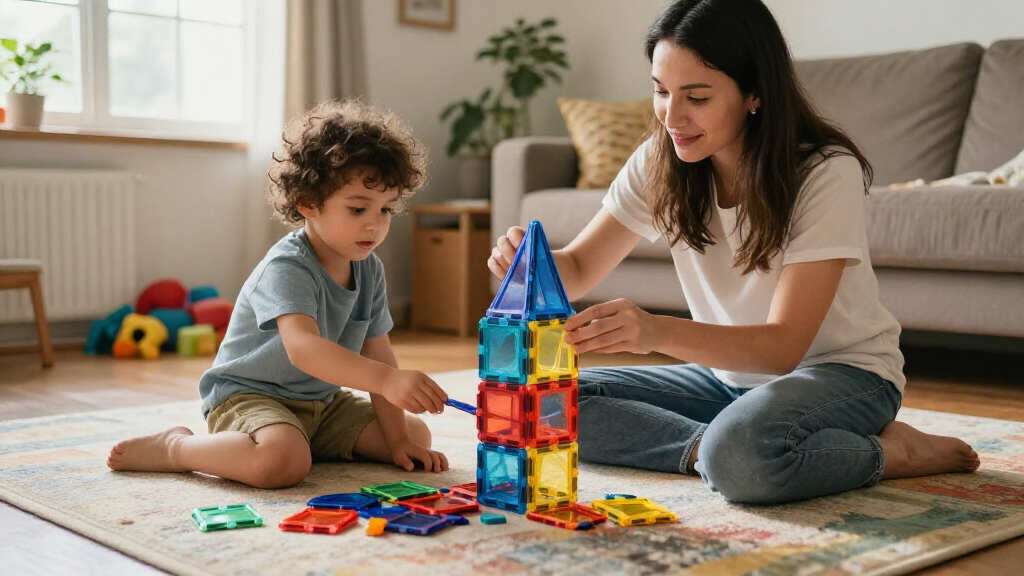
I ranked these kids’ magnetic building tiles by how well each set appears suited to a distinct buyer need, not by piece count alone. I weighed the usefulness of the stated assortment, whether specialty pieces such as cars, road tiles, or castle accessories add a meaningful play direction, and how versatile the set appears for open-ended construction. I also looked for clear entry points for beginners and for options that make sense as an addition to a collection.
The higher-ranked picks are the more flexible choices for everyday building, while smaller, themed, and feature-specific sets rank lower for general use but may be better matches for particular children. Product names and listed contents guide these comparisons; the supplied information does not establish magnet strength, tile dimensions, material safety, or compatibility across brands. I would check those details with the manufacturer before buying, especially when combining sets or shopping for a younger child.
| kids magnetic building tile | Material |
|---|---|
| Mruikeny Magnetic Building Til | ABS plastic |
| Anbalulu Magnetic Building Til | High-transparency plastic |
| FNJO 100-Piece Magnetic Tiles | ABS plastic |
| PicassoTiles 60-Piece Magnetic | Plastic |
| Cossy 120-Piece Magnetic Tiles | ABS plastic |
| Coodoo 60-Piece Magnetic Build | Plastic |
| Anbalulu Magnetic Tiles Buildi | ABS plastic |
| Jasonwell 100-Piece Magnetic T | BPA-free, lead-free material |
| Dopyye 132-Piece Magnetic Buil | ABS plastic |
| Ryoichi 138-Piece Magnetic Til | ABS plastic |
| Soyee Magnetic Tiles Building | — |
| PicassoTiles 100-Piece Magneti | Plastic |
| FNJO Magnetic Building Tiles | ABS plastic |
| Goodtiles Magnetic Road Tiles | Food-grade ABS plastic |
| GobiDex 100-Piece Princess Cas | ABS |
Factors to Consider When Choosing Kids Magnetic Building Tiles
Choosing magnetic tiles is less about finding the largest box and more about matching the contents to how a child plays. These checks can help you judge whether a set will work on its own, complement toys already at home, or become a narrow novelty.
Start With the Kind of Play Your Child Repeats
Notice whether your child prefers making buildings, roads, vehicles, or stories before choosing a set. An open-ended assortment can support many structures, while a road or princess-castle theme gives play a more specific direction. A themed set may be a strong fit when the child already returns to that kind of pretend play, but it can feel limiting if their interests change. For children who like to invent new structures, prioritize a balanced range of basic shapes over accessories that only work in one scene. A useful question is whether the child can start building without an adult explaining the theme. Matching the set to repeated play habits helps avoid buying a high-count box that gets used in only one way.
Read the Piece Mix, Not Just the Total
Piece counts can make two sets look similar even when their building possibilities differ. A count that includes cars, dolls, stairs, or a wheel does not mean the box contains the same number of basic structural tiles as a plain assortment. Look for a contents list that identifies shapes and specialty pieces, then ask whether those parts support the builds your child wants to make. Specialty parts can add play value, but they may also reduce the number of pieces available for walls and roofs. If the listing leaves the breakdown unclear, treat the total as an incomplete measure of building capacity. This is especially helpful when comparing a themed set with a general construction set.
Choose a Size That Fits the Play Space
A large set can support broader structures, but it also needs room to spread out and a reliable place to store its pieces. Before choosing a high-count option, consider whether the child usually builds on a table, floor, or shared play surface. Smaller assortments can be easier to put away and may suit short play sessions, though ambitious builds may run out of pieces sooner. If the child already owns compatible tiles, a smaller set with a distinct feature may add more than another large batch of similar shapes. Check the listed storage details rather than assuming a container is included. Planning around the home’s play space can make a set easier to use regularly.
Treat Cars and Themed Accessories as a Play-Style Choice
Cars, roads, dolls, stairs, and moving components can turn a building set into a more directed play system. That can be useful for children who enjoy making a scene and then using it for pretend play, rather than building structures alone. The tradeoff is that an accessory may be less useful once interest in its theme fades. Before paying extra attention to a feature, check whether it can be used in more than one kind of build and whether the listing describes how it works. For a child who likes both construction and storytelling, a few distinctive accessories may be more valuable than many repeated tiles. For a child who mainly stacks and designs, a simpler assortment may offer more flexibility.
Check Age Guidance, Safety Details, and Compatibility
Follow the manufacturer’s stated age guidance and review its safety information before choosing any magnetic toy. The product names in this roundup do not provide enough detail to compare magnet strength, tile construction, or specific safety certifications. Ask the seller or manufacturer about those details rather than inferring them from appearance or piece count. If you plan to combine brands, confirm compatibility directly; similar-looking tiles are not proof that they connect or perform alike. Also think about how small accessories fit into the child’s play environment and supervision needs. These checks matter more than a feature list when a set will be shared among children of different ages.
Decide Whether You Need a Starter Set or an Add-On
For a first set, prioritize a manageable assortment that lets a child build several simple forms without requiring a large dedicated play area. For an existing collection, a distinct addition—such as road pieces or vehicle components—may broaden play more than another set of basic tiles. Avoid assuming every product line will connect seamlessly with tiles already at home; verify fit and dimensions first. If siblings will share the set, consider whether the listed assortment can support separate projects or whether its special pieces will invite competition. A starter purchase is also a chance to learn which shapes a child actually uses before expanding. That approach can prevent a large collection from growing around features the child rarely chooses.
Frequently Asked Questions
Is a 100-piece set a better first purchase than a smaller set?
Not automatically. A larger assortment can give a child more material for bigger builds, but the total may include cars or other accessories rather than basic tiles. A smaller set such as Soyee’s 32-piece option can be easier to manage while a child learns how magnetic pieces connect. If the child already enjoys construction and has space to spread out, a larger general-purpose set may make more sense. Compare the listed shape breakdown and your child’s play habits before using piece count as the deciding factor.
Should I choose a set with cars or one with standard tiles only?
Choose cars when your child likes making roads, garages, and scenes that lead into vehicle play. Sets such as Cossy’s, Dopyye’s, and Ryoichi’s include two cars, but their value depends on whether those pieces will be used often. A standard assortment is usually the more flexible direction for children who focus on structures or change themes frequently. Check whether the set also has enough basic shapes for the builds your child wants, since accessories contribute to the stated total. When in doubt, match the feature to a play habit you already see rather than hoping it will create one.
Are themed magnetic tile sets a good choice if my child’s interests change?
A themed set can be a good fit when its parts still work for ordinary construction, but it is a less flexible choice if most pieces serve one scene. Road tiles can encourage routes and vehicle play, while a castle set with dolls and stairs leans toward storytelling. Consider whether your child can build structures beyond the named theme and whether the accessories can be stored separately. If interests shift often, a general-purpose assortment is usually the safer core set, with themed pieces added later. This lets you keep construction options broad without ruling out focused play.
Can I combine tiles from different brands?
Do not assume that magnetic tiles from different brands will connect securely just because they look similar. Dimensions, edge design, and magnet placement can vary, and the product details provided here do not confirm cross-brand compatibility. Check the manufacturer’s specifications or ask the seller before mixing sets. If compatibility is uncertain, choose an add-on from the same line or treat the new set as a separate play system. This is especially relevant when a purchase is meant to expand an existing collection rather than start a new one.
What should I check before buying magnetic tiles for a younger child?
Start with the manufacturer’s age guidance and safety information, then review what accessories are included and how they should be handled. The product names alone do not establish magnet strength, construction details, or safety certifications, so get those specifics from the manufacturer. Think about whether the child can play with the set under the supervision appropriate for their age and household. A smaller assortment may be easier to manage, but a low piece count does not replace a safety check. If the listing does not answer your questions, ask before purchasing rather than relying on assumptions.
Conclusion
For most families, PicassoTiles’ 100-piece set is my best overall pick because it offers a broadly useful starting point without centering the choice on a single theme. For best value in flexibility, I’d look first at a general-purpose set with a clear contents list, such as the PicassoTiles 60-piece clear option if a smaller assortment fits your needs; value here means useful pieces for your play style, not simply the highest count. For a premium-style feature set, choose by the play experience you want: Cossy adds two cars, while Jasonwell centers its design around a rotatable Ferris wheel. For beginners, Soyee’s 32-piece set keeps the initial assortment more manageable. For road-focused play, choose Goodtiles; for castle storytelling, consider GobiDex. If you want open-ended building, skip a theme your child may outgrow and prioritize a varied assortment instead.