
Kids’ military history books vary widely: some explain major conflicts, while others focus on individual acts of courage, photographs, activities, or machines. World War II: An Interactive History Adventure is my best overall pick for readers who want an active way into the subject, while World War II: A Visual Encyclopedia of the Second World War stands out for image-led reference and World War II for Kids: A History with 21 Activities for hands-on learning. The main tradeoff is between breadth and accessibility: a broad history can give context, while a focused or interactive book may be easier to engage with but leave gaps. Age, reading level, and comfort with conflict-related material matter as much as the topic. Continue reading for the full comparison and help choosing the right fit.

Turn the school run and nap time into listening time
- Thousands of audiobooks, podcasts and originals
- Listen on your phone, tablet or Echo — also offline
- Cancel anytime
Complete the kit


Key Takeaways
- Interactive learning has a distinct advantage for reluctant readers: the You Choose format offers active decisions, while the activities book adds offline projects rather than branching choices.
- Visual reference books serve a different purpose from narrative histories: the World War II visual encyclopedia and National Geographic Kids titles favor images and quick facts over a continuous account.
- World War II dominates this lineup: readers seeking broader coverage can turn to the World War I and II title or the separate World War I and battles books.
- Biographies and stories can make military history more personal: the 100 Heroes collection and the 15-story volume focus on people and episodes, but offer less of a single, connected overview.
- Military machines are a specialized interest, not a substitute for conflict history: the visual machines book may appeal to vehicle enthusiasts, while readers seeking causes, timelines, and consequences should choose a history-centered title.



| kids military history book | ASIN | Format | Subject | Audience |
|---|---|---|---|---|
| World War II for Teens: A Guid | B0H2CX92RK | Not specified | World War II | Teenage readers |
| World War II: An Interactive H | 142963457X | Interactive history book | World War II | Not specified |
| 100 Heroes of the U.S. Militar | B0HHYJBYWN | — | U.S. military heroes | — |
| World War I and II History for | B0CM3X5TLM | Two books in one | — | Children |
| World War II: A Visual Encyclo | 1465440275 | Visual encyclopedia | World War II | Not specified |
| National Geographic Kids Every | 1426317158 | Book | World War I | — |
| World War II Stories for Kids: | B0D34CDBYQ | Story collection | World War II | Children |
| World War II for Kids: A Histo | 1556524552 | History book with activities | — | Children |
| A Visual History of World Mili | 1497104017 | Visual history | Military vehicles | — |
| National Geographic Kids Every | 1426311001 | Book | Battles | — |
| World War II History for Kids: | 1648763766 | Fact-based book | — | Kids |
| Legends of War: Military Histo | B0FCTZHVT7 | — | — | Children |
More Details on Our Top Picks
World War II for Teens: A Guide to Heroes, Battles, and Turning Points
This is the clearest fit for teens who want a direct introduction to World War II through its people, battles, and turning points. Its teen-focused framing sets it apart from 100 Heroes of the U.S. Military for Kids, which ranges across American military history and is aimed at ages 8–14. Here, the narrower war focus may help an older reader follow one major conflict rather than sample individual service stories across centuries.
The tradeoff is limited detail in the available product information: there is no stated length, format, reading level beyond the teen focus, or list of specific events. I’d choose it for a teenager seeking a general WWII guide, but not for a buyer who needs confirmed chapter coverage, activities, or a visual reference book such as World War II: A Visual Encyclopedia.
Pros:- Concentrates on World War II rather than covering military history across multiple eras.
- Organizes its stated scope around heroes, battles, and turning points.
- Designed specifically for teenage readers.
Cons:- Available details do not identify specific battles, people, or turning points covered.
- Length and format are not provided, making it difficult to judge depth or reading experience.
Best for: Teen readers who want a focused introduction to World War II heroes, battles, and turning points.
Not ideal for: Buyers seeking a verified activity format, detailed contents list, or specifically illustrated reference book, since those details are not provided.
- Subject:World War II
- Topics:Heroes, battles, and turning points
- Audience:Teenage readers
- Format:Not specified
- Length:Not specified
- ASIN:B0H2CX92RK
Our verdict“Choose this for a teen who wants a WWII-focused starting point, but look elsewhere if you need confirmed contents or a defined visual or activity format.”
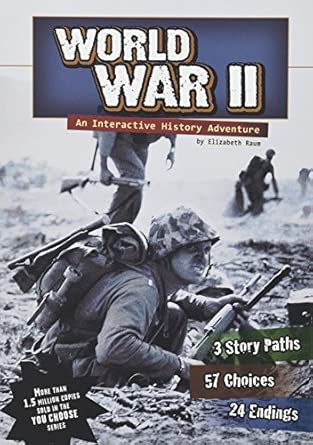
World War II: An Interactive History Adventure (You Choose: History)
For a child who likes choosing what happens next, this interactive WWII history book offers a different route into the subject than a conventional guide. Readers make choices while exploring wartime events and experiences, which can give a reluctant reader a reason to revisit a passage and see how another path changes the story. That makes it a stronger fit for participation than World War II for Teens, whose listed focus is a guide to heroes, battles, and turning points rather than reader-directed choices.
The format is also the main limitation: choices shape the reading experience, but the supplied details do not specify age range, historical topics, or how much factual explanation accompanies each path. I’d pick it for engagement, not as a confirmed reference source. Readers wanting broad visual lookup may be better served by World War II: A Visual Encyclopedia.
Pros:- Reader choices make the history experience participatory rather than purely linear.
- Focused on World War II, keeping the subject narrower than an across-the-centuries military heroes collection.
- Belongs to the You Choose: History series, offering a recognizable interactive approach.
Cons:- The provided information does not identify its intended age range.
- Specific events and the scope of its historical explanations are not listed.
Best for: Children who enjoy branching stories and are more likely to engage with history when they can make choices.
Not ideal for: Readers or caregivers looking for a clearly documented age range, topic list, or visual encyclopedia-style reference.
- Subject:World War II
- Series:You Choose: History
- Format:Interactive history book
- Reading approach:Readers make choices
- Audience:Not specified
- ASIN:142963457X
Our verdict“Pick this for a young reader who enjoys making choices, while favoring a conventional guide or encyclopedia when reference detail matters more than interaction.”
100 Heroes of the U.S. Military for Kids: Inspiring True Stories of Courage, Sacrifice, and Service
This collection is the broadest chronological option among these five: its 100 true stories span from the Revolutionary War to today, rather than concentrating on a single conflict. That range gives children a way to encounter military service across eras, while World War II for Teens offers a narrower route for readers already focused on WWII. The stated ages 8–14 also make its audience more specific than the teen guide or the books with no age information supplied.
The story-by-story approach is a tradeoff as well as a strength. It may suit short reading sessions and personal stories, but the description does not establish how much context connects the stories or which conflicts and people are included. I’d choose it for a child interested in U.S. military figures; for a sustained account of one world war, the two-war collection may fit better.
Pros:- Includes 100 true stories, supporting story-by-story reading.
- Spans U.S. military history from the Revolutionary War to today.
- Provides a stated audience range of ages 8–14.
- Centers on stories of courage, sacrifice, and service.
Cons:- The description does not identify the featured heroes or explain how the stories are organized.
- Its wide historical span may offer less sustained focus on any one war than a dedicated WWII title.
Best for: Children ages 8–14 who want short true stories about U.S. military figures across American history.
Not ideal for: Readers seeking a continuous account of one war or a clearly documented list of the people and episodes covered.
- Subject:U.S. military heroes
- Content:100 true stories
- Time period:Revolutionary War to today
- Recommended age:8–14
- Themes:Courage, sacrifice, and service
- Gift occasion:Veterans Day
- ASIN:B0HHYJBYWN
Our verdict“Choose this for an 8–14-year-old interested in U.S. military stories across eras, not for a reader wanting one conflict explored in depth.”
World War I and II History for Kids: Courageous Tales, Stories, and Fascinating Facts
This two-in-one title earns its place for children who want World War I and World War II together, making it a better match for comparing two major conflicts than the WWII-only World War II: An Interactive History Adventure. Its stated mix of stories, courageous tales, and facts may also give young readers more than one way into the subject, instead of relying on a single reference style.
The breadth comes with a natural compromise: covering both wars may leave less room for detail on either one, and the available description does not give a contents list, age band, or information about how the material is divided. Compared with 100 Heroes of the U.S. Military for Kids, this has a narrower era focus but includes both world wars rather than a sweep of U.S. military history. I’d choose it for a paired introduction, not as a confirmed deep account of either conflict.
Pros:- Covers both World War I and World War II in one book.
- Combines stories, courageous tales, and historical facts.
- A child-focused framing makes its intended audience clear at a general level.
Cons:- The description does not specify how much space or depth each war receives.
- No precise age range or contents list is provided.
Best for: Children beginning to learn about both world wars and families who want a single book covering each.
Not ideal for: Readers who need a stated age range, detailed topic list, or extensive coverage of just one war.
- Subjects:World War I and World War II
- Format:Two books in one
- Audience:Children
- Content:Stories, courageous tales, and historical facts
- Age range:Not specified
- ASIN:B0CM3X5TLM
Our verdict“Choose this for a child who wants an introduction to both world wars in one volume, but seek a single-war title for more focused coverage.”
World War II: A Visual Encyclopedia of the Second World War
The encyclopedia framing makes this the most reference-oriented pick in the group, with a visual approach to World War II rather than a choice-driven story or a collection of individual hero profiles. That distinction matters for young readers who prefer browsing a subject visually; it also separates the book from World War II: An Interactive History Adventure, which asks readers to make choices as they go.
There is not enough product detail here to confirm which images, events, or age range the book includes, so I would not treat “visual encyclopedia” as proof of a particular level of coverage. Compared with World War I and II History for Kids, it focuses on WWII alone, potentially making it a more direct match for that topic, though the supplied information does not establish its depth. I’d favor it for browsing and reference-style reading, while choosing a story-led title for a known narrative format.
Pros:- Uses a visual encyclopedia format rather than a story collection.
- Keeps its focus on World War II.
- May suit readers who prefer browsing reference material over following a linear narrative.
Cons:- The provided details do not specify the images or topics included.
- No age range or further format information is provided.
Best for: Children who prefer visual browsing and want a World War II-focused reference-style book.
Not ideal for: Buyers who need a confirmed age range, a listed set of topics, or evidence of a specific narrative or activity format.
- Subject:World War II
- Format:Visual encyclopedia
- Audience:Not specified
- Coverage detail:Not specified
- Length:Not specified
- ASIN:1465440275
Our verdict“Choose this for a young reader drawn to visual reference books about WWII, but select a story-led option if you want a clearly described reading structure.”
National Geographic Kids Everything World War I
Photographs and accessible facts make this a clear entry point for children beginning to learn about World War I. Its single-conflict focus gives young readers a more direct route into the subject than National Geographic Kids Everything Battles, which covers battles more broadly. That focus can help a child build a basic sense of the war before moving on to books spanning multiple eras or conflicts. The tradeoff is that the supplied details promise an illustrated introduction, not activities, a story collection, or an in-depth analysis. Compared with World War II for Kids: A History with 21 Activities, this book offers no stated hands-on component, and its scope is limited to one war. I’d choose it for a photo-led first look, not as a complete history resource.
Pros:- Photographs offer visual context for a major historical conflict
- Facts provide a direct introduction to World War I
- A single-war focus keeps the subject narrower than a general battles book
Cons:- No activities or story-based format are specified
- Its coverage is limited to World War I
- The supplied details do not establish how much depth or historical context it provides
Best for: Children who want an illustrated, fact-based introduction to World War I
Not ideal for: Readers seeking hands-on projects, detailed analysis, or coverage of multiple wars
- Format:Book
- Subject:World War I
- Publisher:National Geographic Kids
- Content:Photographs and facts
- Approach:Illustrated introduction
- ASIN:1426317158
Our verdict“Choose this for a child who wants a photo-supported introduction to World War I rather than an activity book or broad military survey.”
World War II Stories for Kids: 15 Inspirational Tales of Battles, Leaders, and Heroic Moments
The defining advantage here is its 15-story structure: children can read about World War II through accounts centered on battles, leaders, and heroic moments rather than a single continuous overview. That makes it a more story-oriented pick than World War II for Kids: A History with 21 Activities, which pairs history with hands-on projects. The collection format may also suit readers who prefer shorter, separate topics over a visual survey such as National Geographic Kids Everything World War I. The tradeoff is that the provided description does not say how the stories balance military events with wider historical context, or whether the book includes maps and images. I’d select it for a child drawn to people and episodes, while choosing another title for activities or a clearly described visual format.
Pros:- Organizes the subject into 15 individual stories
- Includes battles, leaders, and heroic moments
- Written for a child audience
- Story format offers a different entry point from activity-based histories
Cons:- The supplied description does not specify maps, photographs, or other visual aids
- The collection format may provide less continuity than a single chronological account
- The degree of historical context and detail is not specified
Best for: Young readers who stay engaged through separate stories about World War II battles, leaders, and acts of courage
Not ideal for: Children looking for hands-on activities, a visual reference book, or a clearly outlined chronological history
- Subject:World War II
- Audience:Children
- Number of stories:15
- Topics:Battles, leaders, and heroic moments
- Format:Story collection
- ASIN:B0D34CDBYQ
Our verdict“Pick this for children who prefer a set of focused World War II stories over activities or a visual encyclopedia.”
World War II for Kids: A History with 21 Activities
Twenty-one activities set this book apart from the story-first approach of World War II Stories for Kids. Rather than relying only on reading, it gives children ways to engage with the subject through hands-on work alongside historical content. That combination makes it a strong fit for families or educators who want an activity to reinforce a lesson, not just another account of battles and leaders. Compared with National Geographic Kids Everything World War I, its stated appeal is participation rather than photographs. The tradeoff is that activities take time and may not suit a child who wants a straightforward read-through; the supplied details also do not identify the activities or their materials. I’d rank it ahead of narrative options for interactive learning, but not for a child seeking a concise, uninterrupted history.
Pros:- Combines historical content with 21 activities
- Designed for young readers
- Activities offer a participatory alternative to story-only books
- Its World War II focus keeps the subject specific
Cons:- Activity-based reading may not suit children who want a continuous history
- The supplied details do not describe the activities or any required materials
- No specific visual aids or scope of historical coverage are provided
Best for: Parents and educators seeking World War II reading paired with activities for children
Not ideal for: Children who prefer a continuous narrative or families wanting activities with fully specified materials and instructions before choosing
- Topic:World War II
- Audience:Children
- Activities:21
- Format:History book with activities
- ASIN:1556524552
- Content approach:Historical content combined with hands-on activities
Our verdict“Choose this when a child will learn more from pairing World War II reading with activities than from stories alone.”
A Visual History of World Military Machines: Inside the World’s Most Incredible Combat Machines
This title takes a different route from the conflict-centered books: its subject is military machines, spanning examples such as Spitfires, U-Boats, Humvees, and Stealth Bombers. The visual-history format and coverage of air, sea, and land vehicles make it a better fit for a child fascinated by engineering and equipment than World War II for Kids: A History with 21 Activities, which centers on one war and adds projects. Its range across eras also sets it apart from National Geographic Kids Everything World War I, whose focus is a particular conflict. The tradeoff is a narrower lens on military history: vehicle design may crowd out battles, people, and broader context. The description also notes that technical detail is limited, so readers wanting extensive specifications may need another reference.
Pros:- Covers combat machines from air, sea, and land
- Includes vehicles from different eras
- Visual format suits readers drawn to imagery and design
- Examples range from Spitfires and U-Boats to Humvees and Stealth Bombers
Cons:- Vehicle focus gives less space to broader conflict history and human stories
- The visual approach may not provide extensive technical specifications
- Niche subject may not suit children looking for a general military history
Best for: Children especially interested in military aircraft, ships, and land vehicles across different eras
Not ideal for: Readers seeking a broad account of wars, battle narratives, or extensive technical specifications
- Publisher:Fox Chapel Publishing
- Subject:Military vehicles
- Format:Visual history
- Vehicle categories:Air, sea, and land combat machines
- Examples:Spitfires, U-Boats, Humvees, and Stealth Bombers
- ASIN:1497104017
Our verdict“Choose this for a young reader whose main interest is military vehicle design, not a broad history of battles and conflicts.”
National Geographic Kids Everything Battles: Arm Yourself with Fierce Photos and Fascinating Facts
Battle-focused facts and photographs give this book a wider subject than National Geographic Kids Everything World War I, which concentrates on one conflict. That broader framing may suit children who want to browse battle topics without beginning with a single war’s history. It also distinguishes the book from A Visual History of World Military Machines: this title is framed around battles, while that one centers on vehicles and engineering. The supplied product details are sparse, though, so I can’t tell which battles appear, how they are grouped, or how much context accompanies the images. I’d treat it as a photo-and-fact browsing option rather than a substitute for a clearly scoped history such as World War II for Kids: A History with 21 Activities. The main tradeoff is less certainty about depth and coverage.
Pros:- Features photographs alongside facts
- Battle-centered subject is broader than a single-war title
- National Geographic Kids presentation is aimed at young readers
- Offers a different focus from vehicle-centered military histories
Cons:- Supplied details do not identify the battles covered
- No activity component or level of historical depth is specified
- Broad battle coverage may offer less context than a focused war history
Best for: Children who like browsing photographs and facts about battles across a broad military-history subject
Not ideal for: Families seeking a defined war-by-war scope, activities, or detailed information about the book’s specific topics
- Format:Book
- Publisher:National Geographic Kids
- Subject:Battles
- Content:Photographs and facts
- Title subtitle:Arm Yourself with Fierce Photos and Fascinating Facts
- ASIN:1426311001
Our verdict“Choose this for a child who enjoys photo-led browsing about battles, but choose a focused history for defined coverage and context.”
World War II History for Kids: 500 Facts
World War II History for Kids: 500 Facts is the clearest fit here for young readers who like learning in short, self-contained pieces. Its stated 500-fact format promises plenty of bite-sized material on one conflict, which may suit browsing or quick reading better than a narrative-led book such as World War II Stories for Kids: 15 Inspirational Tales of Battles, Leaders, and Heroic Moments. That breadth is appealing, but the available description does not say how facts are organized, whether illustrations are included, or how much context connects one fact to another. Readers seeking fuller accounts of battles or individual lives may prefer a story-focused title such as Legends of War. I’d choose this book for fact collecting and casual exploration, not as a clearly documented, in-depth guide.
Pros:- Presents 500 facts focused on World War II
- Bite-sized fact format may work well for short reading sessions
- Designed for a young audience
- Single-war focus keeps the subject more concentrated than books spanning both world wars
Cons:- Available details do not explain how the facts are grouped or whether they build a coherent historical overview
- No information is provided about illustrations, maps, or other visual support
- The description does not indicate how much context accompanies individual facts
Best for: Young readers who enjoy short facts and want a broad introduction to World War II without committing to a continuous narrative
Not ideal for: Children looking for illustrated battle accounts, detailed explanations, or a verified activity-based format, since those features are not specified in the available product information
- Topic:World War II
- Audience:Kids
- Number of facts:500
- Format:Fact-based book
- Historical focus:World War II
- ASIN:1648763766
Our verdict“Choose this for a child who prefers plentiful, short World War II facts, but pick a story-led title for connected accounts of battles and people.”
Legends of War: Military History for Kids — WWII Battles and Unsung Heroes
Legends of War: Military History for Kids — WWII Battles and Unsung Heroes stands apart by pairing World War II battles with the people who took part in them, including less-recognized figures. That emphasis gives it a more human-centered angle than World War II History for Kids: 500 Facts, whose stated format prioritizes a large collection of facts rather than personal stories. It may suit a child who connects with history through individual actions and true accounts, while readers wanting a quick-reference style may be better served by the facts book. The description does not identify which battles or heroes appear, how many stories are included, or whether the book uses maps or illustrations. I’d treat its story-led focus as the main draw, while noting that the scope and presentation remain unclear from the supplied details.
Pros:- Focuses on true stories connected to World War II battles
- Highlights unsung heroes rather than only well-known figures
- Aimed at children
- People-centered approach offers a contrast to fact-collection books
Cons:- Available description does not name the battles or heroes covered
- No information is provided about the number or length of stories
- Illustrations, maps, and other format details are unspecified
Best for: Children drawn to true accounts of World War II battles and the people whose contributions receive less attention
Not ideal for: Readers who want a fact-counted reference, a known list of battles and figures, or confirmed details about illustrations and book format
- Topic:World War II military history
- Audience:Children
- Content focus:True stories from World War II battles
- People featured:Unsung heroes
- Historical focus:World War II
- ASIN:B0FCTZHVT7
Our verdict“Pick this for a child more interested in personal stories from World War II battles than in collecting a large set of standalone facts.”
How We Picked
I compared the 12 books by how clearly each serves a young reader’s purpose: building an overview, exploring a particular war, meeting historical figures, browsing visual reference, or learning through participation. I also considered signals in the titles about intended audience, format, scope, and likely reading demands. Since the lineup spans teens, kids, fact collections, stories, encyclopedias, and activities, I treated age fit and learning style as meaningful differences rather than assuming one format works for every child.
The order prioritizes breadth of usefulness for families looking for an approachable starting point, then gives strong positions to books with a clear format or subject advantage. Focused books rank lower for general use when they cover only one angle, such as individual heroes or military machines, though that focus can make them a better match for a specific reader. I also weighed the limits implied by each approach: an interactive format may simplify events into choices, a facts collection may lack narrative context, and a visual reference may invite browsing without providing a connected account.
| kids military history book | Subject | Audience |
|---|---|---|
| World War II for Teens: A Guid | World War II | Teenage readers |
| World War II: An Interactive H | World War II | Not specified |
| 100 Heroes of the U.S. Militar | U.S. military heroes | — |
| World War I and II History for | — | Children |
| World War II: A Visual Encyclo | World War II | Not specified |
| National Geographic Kids Every | World War I | — |
| World War II Stories for Kids: | World War II | Children |
| World War II for Kids: A Histo | — | Children |
| A Visual History of World Mili | Military vehicles | — |
| National Geographic Kids Every | Battles | — |
| World War II History for Kids: | — | Kids |
| Legends of War: Military Histo | — | Children |
Factors to Consider When Choosing Kids Military History Books
Before choosing a title, I would match the book to the reader’s reason for being interested in military history. A child looking for a first overview needs a different format from a teen researching World War II or a young reader drawn to aircraft, armor, and photographs. These broader checks can help you avoid buying a book that is interesting on its subject but mismatched to the way your reader likes to learn.
Match the reading level, not just the age label
A book described for kids may still assume comfort with dates, unfamiliar place names, and military vocabulary. Teen-focused writing can offer more room for context, but it may not suit a younger child who wants shorter passages and frequent visual breaks. If you are choosing for a mixed-age household, think about whether the book can be browsed in small sections or whether it relies on sustained reading. Read a sample when available, especially if the child is new to nonfiction. A title that feels manageable is more likely to lead to follow-up questions than one chosen only because the topic is appealing.
Choose a format that fits how the child learns
Narrative histories help readers connect events across time, while encyclopedias and fact books support quick browsing and topic-by-topic discovery. Interactive books give the reader choices, and activity-based books turn reading into a practical project. Those formats are not interchangeable: activities can add engagement without supplying a full chronological account, and a collection of facts may be memorable but fragmented. Consider whether the child enjoys reading a chapter from start to finish, flipping through images, or doing something with the information. For a first purchase, a format the child already enjoys can matter more than maximum coverage.
Check the subject scope before buying
World War II receives the most attention across this selection, so a child already familiar with that war may benefit from a World War I title or a broader battles book instead. A book that covers two wars can offer comparisons, though it may have less room for detail on either one. A focused title can be a good match for a school project or a strong existing interest, but it may leave important background unexplained. Look for the historical question the child wants answered: what happened, who took part, how battles unfolded, or what machines were used. This makes it easier to distinguish a useful specialization from a book that is simply too narrow for the goal.
Think about emotional readiness and framing
Military history includes violence, loss, and difficult choices, even when a book is written for young readers. A child may be ready for dates and maps but not detailed descriptions of combat or its human costs. Consider whether the book foregrounds battles, personal stories, technology, or acts of service; each framing can lead to a different conversation. For younger readers, reading together gives you a chance to explain context and pause when a topic feels heavy. Avoid assuming that an accessible format automatically means the material will feel emotionally easy.
Decide whether you need a reference book or a reading journey
Reference titles are useful when a child wants to revisit facts, compare topics, or find an answer quickly. A narrative or story collection is often a better fit when the goal is sustained reading and a sense of how people and events connect. Families sometimes buy an encyclopedia expecting it to teach a complete sequence, or choose a story collection expecting a full historical survey; those are different jobs. If the book will support homework, check whether it offers enough context for the assignment rather than only appealing details. For a home library, pairing one broad account with a specialized visual or biography book can fill more needs than asking one title to do everything.
Prioritize depth, engagement, or specialization
When choosing between books, decide which limitation you would accept: less historical breadth, fewer interactive elements, or less visual material. A general overview is usually the more flexible choice, while a specialist book can be more rewarding for a child already invested in a particular war, hero, or machine. A premium-format visual reference may suit frequent browsing, but it is not automatically better for a child who wants a clear beginning-to-end explanation. For a reluctant reader, engagement can be worth more than exhaustive coverage. For a school-age reader building background knowledge, context and organization may matter more than novelty.
Frequently Asked Questions
Which kind of kids’ military history book is best for a reader who is new to the subject?
I would start with a book that gives clear context and does not assume the child already knows the timeline or key terms. A narrative or broad overview can establish who was involved and how events relate, while an interactive title may help a reader who is more motivated by choices than by straight exposition. Avoid starting with a machine-focused book if the child wants to understand the war itself; it may offer an engaging entry point but a narrower view. If you are unsure about reading stamina, sample a few pages together before choosing.
Are interactive military history books a good fit for school learning?
They can help a child engage with decisions and consequences, but a choice-based story should not be treated as a complete historical record. Choices are a teaching device, and real events rarely reduce neatly to a small set of options. For a school assignment, pair interactive reading with a source that explains the broader timeline and historical context. Ask the child to separate what the book presents as a possible path from what actually happened. That distinction can make the format useful without confusing historical fact and imagined participation.
Should I choose a World War II book or one that covers multiple conflicts?
Choose a focused World War II book when that is the child’s main interest or the subject of a current project; a narrower scope can leave more room for detail. A book spanning World War I and World War II may work better when the reader wants to compare conflicts or build a wider timeline. The tradeoff is that broader coverage may move quickly through events that a dedicated title explains at greater length. If the child already knows one war well, a book on a different conflict can expand their perspective more than another general World War II overview.
How can I tell whether a book about battles or military machines gives enough historical context?
Check whether the book connects equipment or battles to the people, goals, and events surrounding them. A visual focus can make details easy to explore, but images and specifications alone may not explain why a battle mattered or how a machine was used. Look for introductions, timelines, maps, captions, and explanations of outcomes rather than relying on the subject title. If context is limited, the book can still suit a strong specialist interest, but pair it with a broader history for a fuller picture. This is particularly useful when the child needs information for classwork.
How do I choose a military history book that feels appropriate for a younger child?
Look beyond the word “kids” and consider reading level, illustration style, and how directly the book discusses combat and loss. A facts or visual title may be easier to browse, but images can still depict intense subject matter. Read a sample or review the contents before handing it over, and be ready to talk through questions that come up. For a younger reader, short sections and clear explanations can help, but they do not remove the need to judge emotional readiness. Choosing together can also show whether the child is drawn to stories, history, or vehicles.
Conclusion
For the broadest starting point, I would choose World War II: An Interactive History Adventure as best overall, especially for a reader who responds to participation. My best value pick is World War II History for Kids: 500 Facts for quick browsing and bite-sized discovery, while the visual encyclopedia is my best premium-style choice for readers who want an image-led reference book. For beginners who prefer hands-on learning, World War II for Kids: A History with 21 Activities is the clearest fit; younger readers drawn to personal accounts may prefer 100 Heroes of the U.S. Military for Kids. For specific interests, choose A Visual History of World Military Machines for combat vehicles, National Geographic Kids Everything World War I for that earlier conflict, or the battles title for image-rich browsing. Match the book to the child’s reading habits and purpose, and remember that a focused title may complement a broader history better than replace it.