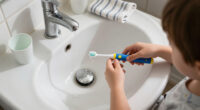
This guide helps parents and caregivers choose a child-friendly electric toothbrush, prepare it for use, and teach a child a gentle, thorough brushing routine. It is for beginners; no special dental skills are needed. Allow 30-60 minutes to compare products and set up the brush, then about two minutes for each brushing session. A toothbrush supports daily care but does not replace advice from your child’s dentist.

Turn the school run and nap time into listening time
- Thousands of audiobooks, podcasts and originals
- Listen on your phone, tablet or Echo — also offline
- Cancel anytime

SAKYPRORAL Kids Electric Toothbrush for Teens (Ages 6-15), Smart AI Screen with Brushing Score, Soft Bristles, Visual Timer, 150-…
- ✔ Age range: 6–15 years
- ✔ Cleaning modes: 5, including Gentle
- ✔ Bristles: Soft end-rounded Dupont bristles

Kids Electric Toothbrush – Rechargeable Vibrating Toothbrush with Timer, Shark Design, 6 Replacement Heads
- ✔ Age range: 2+ years
- ✔ Design: Shark-themed
- ✔ Power: Rechargeable

Kids Electric Toothbrush – Rechargeable, 6 Heads, Ages 2-12, Blue
- ✔ Age range: 2–12 years
- ✔ Cleaning modes: Clean, Sensitive, Massage
- ✔ Timer: 2 minutes with 30-second alerts
Difficulty: Beginner | Time: 30-60 minutes to choose and set up; 2 minutes per brushing
What You’ll Need
Tools & Materials:
- A child-sized toothbrush head and handle, or a product specifically labeled for the child’s age
- Fluoride toothpaste recommended for the child’s age
- A sink, clean water, and a towel
- A charger or batteries that match the toothbrush model, if needed
- A timer or built-in two-minute timer
Knowledge:
- Your child’s age and any dental or sensory needs that affect brushing
- How to read the toothbrush manufacturer’s age, charging, and cleaning instructions
- The child’s current toothpaste guidance from a dentist or local dental-health authority
Product features and recommendations vary by child and model. Check the manufacturer’s instructions and ask your child’s dentist if the child has braces, sensitive gums, a strong gag reflex, a medical condition affecting oral care, or difficulty tolerating vibration. Do not select a brush based on characters or app features alone. Choose one your child can comfortably hold and that lets an adult reach every tooth.
For toothpaste amount and fluoride guidance, follow the packaging and your dental professional’s advice. Keep the brush, charging base, and small detachable parts out of reach of young children when they are not supervised.
SAKYPRORAL Kids Electric Toothbrush for Teens (Ages 6-15), Smart AI Screen with Brushing Score, Soft Bristles, Visual Timer, 150-…
SAKYPRORAL earns our top spot because it makes brushing progress visible right on the handle. Its screen displays a brushing score and highlights missed zones, giving children a concrete prompt to improve coverage without requiring a phone or companion app. That distinction matters: the blue ages 2–12 brush offers useful timer alerts and modes, but it does not describe the same immediate zone-by-zone feedback.The age range of 6–15 makes this a stronger fit for school-age children and teens than for toddlers beginning to brush. Five modes, including Gentle, and soft end-rounded bristles give families some flexibility, including when a child has braces or sensitive gums, as described by the product. A three-minute timer with 30-second intervals supports a longer routine than the two-minute timers on the other two options. Its stated battery life of up to 150 days and included travel case also suit camps and frequent trips.There are limits to that feature set. The score display is not the same as app-based tracking, and the product has no Bluetooth connection for families who want to review brushing patterns on a phone. We also do not have a stated count of included replacement heads in the supplied details. Compared with the more playful shark brush, this model prioritizes coaching over character appeal; it makes the most sense when a child is old enough to use feedback constructively.
Pros:
- On-handle score and missed-zone feedback need no phone
- Five modes include a Gentle option
- Stated battery life of up to 150 days and a travel case
- Three-minute timer uses 30-second interval prompts
Cons:
- No Bluetooth or companion app for advanced tracking
- Age range starts at 6, so it is not the youngest-child pick
- Supplied details do not state how many replacement heads are included
Best for: School-age children and teens who rush or miss areas and can use on-handle feedback to improve their brushing routine.
Not ideal for: Toddlers, families specifically seeking app or Bluetooth tracking, or buyers who need a clearly stated replacement-head bundle.
Bottom line: For children old enough to respond to feedback, SAKYPRORAL offers the clearest brushing guidance in this group, though its smart screen cannot replace app-based tracking.
“For children old enough to respond to feedback, SAKYPRORAL offers the clearest brushing guidance in this group, though its smart screen cannot replace app-based tracking.”
Kids Electric Toothbrush – Rechargeable Vibrating Toothbrush with Timer, Shark Design, 6 Replacement Heads
For a child who needs a reason to approach the sink willingly, the shark theme is the defining advantage. This is the youngest-age option in the group, with a stated range of 2 and up, and it keeps the feature list uncomplicated: a rechargeable brush, a two-minute timer, and six heads total. That makes it easier to understand as a starter choice than SAKYPRORAL, whose screen, scores, and longer timer target older children.The supplied description says the brush is dentist-designed and carries the ADA Seal of Acceptance. Those are useful distinguishing claims for shoppers comparing basic options, but the appeal here is still its combination of an engaging design and a simple routine rather than detailed brushing coaching. Six heads also give families a larger stated supply than the details provide for SAKYPRORAL. Compared with the blue ages 2–12 brush, however, this model does not list three cleaning modes, a travel case, or 30-second interval alerts.We would check that the playful look suits the child and that the brush head is comfortable for their mouth; a theme alone does not teach thorough coverage. The description also warns that packaging may differ from product images, so presentation may not match expectations. This brush is a sensible first step for a younger child, but families dealing with repeated missed areas may prefer SAKYPRORAL’s feedback, while those wanting mode options should consider the blue brush.
Pros:
- Shark design can make the routine more inviting
- Stated age range begins at 2+
- Includes six brush heads total
- Rechargeable design and a two-minute timer
Cons:
- No listed cleaning modes or missed-zone coaching
- Does not specify a travel case or battery-life duration
- Packaging may differ from product images
Best for: Younger children who are beginning an electric-brushing routine and respond to playful character designs.
Not ideal for: Older children who want brushing feedback, or families seeking multiple modes, a travel case, or interval alerts.
Bottom line: Choose the shark-themed brush to make an uncomplicated first electric-brushing routine more appealing, not when a child needs detailed technique guidance.
“Choose the shark-themed brush to make an uncomplicated first electric-brushing routine more appealing, not when a child needs detailed technique guidance.”
Kids Electric Toothbrush – Rechargeable, 6 Heads, Ages 2-12, Blue
This blue rechargeable brush occupies the middle ground between the shark brush’s simplicity and SAKYPRORAL’s coaching screen. Its stated age range of 2–12 covers younger children through preteens, while three modes—Clean, Sensitive, and Massage—offer more adjustment than the shark option. A two-minute timer with 30-second alerts gives children a clear structure for moving through a brushing session, although it does not identify missed zones as SAKYPRORAL does.Families who travel may value the included case and stated battery life of up to 45 days under the specified use assumption of four minutes daily. Six heads are included, and the brush is described as having silicone-wrapped soft heads. These details make it a more configurable all-rounder than the shark-themed model, whose description lists fewer usage features. The claimed 39,600 vibrations per minute is a specification, not a reason by itself to assume better brushing; a child’s comfort and technique remain central.The main practical snag is charging: an adapter is not included, so families may need a compatible one already at home. Its stated six-hour charging time and 45-day battery life are useful planning details, but the battery claim is not as long as SAKYPRORAL’s stated up-to-150-day duration. The product information also says heads need replacement after about 18 months; families should follow the manufacturer’s current guidance and their dental professional’s advice. Choose this model for variety and portability, rather than for the most direct brushing feedback.
Pros:
- Three modes include Sensitive and Massage
- Two-minute timer includes 30-second alerts
- Includes six heads and a travel case
- Stated battery life of up to 45 days
Cons:
- Charging adapter is not included
- Battery-life claim is shorter than SAKYPRORAL’s stated maximum
- Does not list a brushing score or missed-zone display
Best for: Families wanting an age-spanning brush with multiple modes, interval prompts, six heads, and a travel case.
Not ideal for: Buyers who need an included charging adapter or children who need zone-level feedback to brush thoroughly.
Bottom line: This is the most adjustable travel-ready choice for a broad age range, provided you are comfortable supplying a compatible charging adapter.
“This is the most adjustable travel-ready choice for a broad age range, provided you are comfortable supplying a compatible charging adapter.”
As an Amazon Associate we earn from qualifying purchases.
Before You Start
Plan for adult supervision, particularly for young children. A child can practice holding and moving the brush, but a caregiver may need to finish brushing until the child has the coordination to clean all surfaces reliably. Never let a child chew the brush head, play with the charger, or use the brush without its head attached. If brushing causes pain, bleeding that persists, or unusual gum irritation, stop and contact a dentist.
Electric brushes may use a rotating-oscillating or sonic brushing action. Either type can clean effectively when used correctly. A soft-bristled head, comfortable grip, appropriate size, and a mode the child tolerates matter more than extra features. Avoid assuming that a child needs a specific brand or technology.
Step-by-Step Instructions
Step 1: Check your child’s age and needs
Read the age range on each toothbrush package and remove options not intended for your child’s age. Check the manufacturer’s directions for head replacement, supervision, charging, and any warnings. Think through practical needs: a small mouth may need a compact head, a child with limited grip may need a thicker handle, and a child sensitive to vibration may need a gentler setting or a manual brush instead.
Ask your child’s dentist for product or technique advice if the child has braces, dental work, recurring sensitivity, or difficulty brushing. Do not assume a brush marketed for children is suitable for every child in that age group.
Tip: A child-friendly design should make brushing easier, not turn the brush into a toy during use. Choose a model with a handle your child can grip and a head that fits comfortably at the back of the mouth.
Check: You have a shortlist of models labeled for your child’s age, with no unresolved fit or dental-care concerns.
Step 2: Compare the brush head and controls
Look for a soft-bristled, small or compact head and a handle that is easy to hold. Check that the replacement heads are available and that you can identify when to replace them. Choose simple controls your child can understand. A two-minute timer or pacing signal can help, but it is not a substitute for guiding the brush across every tooth surface.
Review the cleaning mode options, noise, charging method, and cost of replacement heads. If possible, let your child hold the switched-off brush in a shop or at home before purchase. Avoid heads that look too large to move comfortably around the child’s back teeth.
Tip: A timer can prompt the child to keep brushing, but make sure the child knows to brush gently and cover the outside, inside, and chewing surfaces.
Check: The selected brush has an age-appropriate head, soft bristles, manageable controls, and replacement heads you can obtain.
Step 3: Choose a brush your child will tolerate
Ask your child which acceptable color, handle style, or character they prefer, then make the final choice based on fit and instructions. If the child is unsure about vibration or sound, let them hold the brush while it is off and explain that the bristles touch the teeth gently. Do not switch it on unexpectedly near the child’s face.
If the child strongly dislikes the sound or sensation, compare a quieter model or try a manual toothbrush while you ask a dentist for guidance. An electric toothbrush is not required for every child; a brush the child will use properly is the more useful choice.
Tip: Introduce the brush without pressure. A short look or brief supervised practice with the brush off can make the first brushing less surprising.
Check: Your child can hold the brush and is willing to try it, or you have chosen a suitable alternative to discuss with the dentist.
Step 4: Prepare and inspect the toothbrush
Unpack the brush and attach the correct head according to the manufacturer’s directions. Charge the handle or install the specified batteries before the first full brushing. Keep charging parts dry unless the instructions say otherwise, and place the charger where the child cannot pull on its cord.
Check that the head is secure, the bristles are intact, and the handle has no cracks or loose parts. Rinse the head with clean water. Read the instructions for cleaning and storage; do not immerse the handle unless the manufacturer permits it.
Tip: Do not use a damaged brush, loose head, or incompatible replacement head. If a part does not fit easily, stop and check the model number rather than forcing it.
Check: The correct head is firmly attached, the brush is powered, and the handle and bristles are undamaged.
Step 5: Set out toothpaste and demonstrate gentle brushing
Follow the toothpaste label and your dentist’s advice for the amount of fluoride toothpaste appropriate to your child’s age. Put it on the bristles yourself for a young child, and supervise the child to limit swallowing. Have the child stand or sit securely at a sink, then show how to guide the brush rather than scrub hard.
Switch on the brush only after the head is inside the mouth, unless the product instructions say otherwise. Place the bristles against the teeth and gumline gently. Move slowly from tooth to tooth, covering outer, inner, and chewing surfaces. For an electric brush that performs the brushing motion, do not rapidly scrub back and forth; follow the model’s instructions for positioning and movement.
Tip: Use a mirror and a simple route, such as upper outside, upper inside, upper chewing surfaces, then repeat below. A consistent route reduces missed areas.
Check: The child uses a suitable amount of toothpaste, keeps the bristles on the teeth, and brushes with light pressure rather than forceful scrubbing.
Step 6: Brush for two minutes with adult help
Start the timer and guide the brush around the mouth until two minutes have passed, unless your dentist has given different instructions. Divide the time among the four areas of the mouth so each gets about 30 seconds. Watch that the child reaches the back teeth and the inside surfaces, which are easy to skip.
Let the child hold the handle if they can do so safely, but take over or guide their hand when needed to complete the job. Pause if the child needs to spit or is uncomfortable. Do not force the brush deep into the mouth or leave the child alone with a powered brush.
Tip: The timer measures time, not coverage. Check each area before moving on, and keep the brush pressure gentle.
Check: Two minutes have elapsed and all four mouth areas, including inner and chewing surfaces, have been brushed.
Step 7: Rinse, store, and plan replacement
After brushing, follow the toothpaste label or dental advice about spitting and rinsing. Rinse the toothbrush head under clean water, shake off excess water, and store it upright where it can air-dry without touching other brush heads. Keep it away from toilet spray and avoid covering a damp head in a closed container.
Check the bristles regularly. Replace the head at the interval given by the manufacturer or dentist, and sooner if the bristles are frayed or damaged. Follow the product’s battery and charging guidance, and keep the charger out of the child’s reach.
Tip: Write the replacement date on a calendar or set a reminder based on the product instructions so a worn head does not stay in use unnoticed.
Check: The head is clean, upright, and able to dry; you know when and how to check it for replacement.
Common Mistakes to Avoid
- Choosing a brush with a head that is too large or not labeled for the child’s age. — Check the stated age range and choose a compact head that can reach the back teeth comfortably. Ask a dentist if the fit is uncertain.
- Pressing hard or scrubbing quickly with an electric brush. — Use light pressure and follow the manufacturer’s positioning instructions. Let the brush do its brushing action; guide it slowly across the teeth.
- Letting the child brush alone before they can clean all areas. — Supervise and finish or correct the brushing as needed. Keep checking coverage rather than relying only on the timer.
- Using a worn head or an incompatible replacement. — Match replacement heads to the exact brush model and replace them according to the product guidance or sooner if bristles fray.
Troubleshooting
Problem: The child refuses the sound or vibration.
Solution: Turn the brush off and let the child inspect and hold it without pressure. Try a gentler or quieter model, introduce brief supervised practice, or use a suitable manual brush. Ask the dentist for suggestions if resistance continues.
Problem: The child gags or says the head feels too large.
Solution: Stop, remove the brush, and check the head size and placement. Try a smaller child-appropriate head if the model allows it. Do not push the brush toward the throat; seek dental advice if gagging persists.
Problem: The gums hurt or bleed during brushing.
Solution: Reduce pressure and check that the bristles are soft and undamaged. If pain or bleeding continues, is heavy, or occurs repeatedly, stop using the brush and contact a dentist for an examination and technique advice.
Problem: The brush does not turn on or the timer does not work.
Solution: Check the charge or batteries, confirm the head is attached as instructed, and consult the model’s troubleshooting directions. Do not use a damaged charger or force a part into place; contact the manufacturer if the problem remains.
What Success Looks Like
The child has an age-appropriate, comfortable brush with a secure, intact head. During supervised brushing, the child or caregiver uses the recommended toothpaste amount, applies gentle pressure, and covers the outer, inner, and chewing surfaces of all four mouth areas for about two minutes, following any dentist-specific instructions. Afterward, the brush is rinsed and stored upright to air-dry. The child is comfortable enough to repeat the routine morning and evening.
Next Steps
Keep supervising until your child can consistently brush every surface without reminders or missed areas; the age at which a child can manage this varies. Maintain the routine twice daily and continue regular dental visits. Check the head often for wear, replace it according to product or dental guidance, and ask the dentist to review technique at the next appointment. Revisit the brush choice if the child’s mouth, grip, braces, or comfort needs change.
Frequently Asked Questions
At what age can a child use an electric toothbrush?
Use a model labeled for the child’s age and follow its instructions. Readiness also depends on comfort, coordination, and supervision. Ask the child’s dentist if the age guidance or fit is unclear.
Is an electric toothbrush better than a manual toothbrush for children?
Either type can support effective brushing when the child or caregiver uses it thoroughly and gently. Choose the type your child tolerates and can use with appropriate help; an electric brush is not required for every child.
How much toothpaste should I use?
Use the amount and fluoride concentration stated on the toothpaste packaging and recommended by your child’s dentist or local dental-health authority. Supervise young children so they spit rather than swallow toothpaste.
How long should my child brush?
A common routine is two minutes, twice a day, with all tooth surfaces covered. Follow your dentist’s instructions if they recommend a different approach for your child.
When should I replace the toothbrush head?
Follow the manufacturer’s schedule and your dentist’s advice. Replace it sooner if the bristles are frayed, damaged, or no longer clean effectively, and use only a head compatible with the exact model.
Columbus Day / Indigenous Peoples' Day Picks
long weekend sales
As an affiliate, we earn on qualifying purchases.