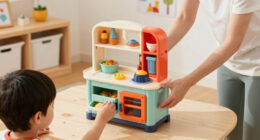

Educational toys for toddlers work best when they invite children to practice a skill through play, not just watch or listen. I’d put the Melissa & Doug Wooden Building Blocks first for open-ended building, while the Learning Resources Spike Hedgehog stands out for hands-on fine-motor practice and the LeapFrog Learning Friends 100 Words Book for guided vocabulary play. The main tradeoff is between flexible, child-led toys and toys that teach through prompts, sounds, or specific tasks. I also weigh age fit, small-piece demands, durability, and how much adult help a toy may need. Read on for the full comparison and a recommendation matched to your toddler’s interests.

Turn the school run and nap time into listening time
- Thousands of audiobooks, podcasts and originals
- Listen on your phone, tablet or Echo — also offline
- Cancel anytime
Complete the kit


Key Takeaways
- Open-ended play gives the blocks a broad role: The Melissa & Doug wooden blocks can support building, sorting, and pretend play, while most other picks focus on a narrower skill or activity.
- Fine-motor practice does not have to mean a screen: Spike, the shape sorters, puzzles, and the farm train all invite children to grasp, place, or match pieces, with different levels of task structure.
- Electronic learning toys trade flexibility for guidance: The LeapFrog book, Scribble, Write and Read, LeapTop Touch, and talking cards offer prompts and feedback, but are less open-ended than wooden toys.
- Several products overlap heavily: The two 224-word talking-card sets target similar vocabulary practice, so buyers should compare controls, included materials, and practical upkeep rather than assume both are needed.
- Age labels do not replace supervision and fit checks: The puzzle sets, loose blocks, tiles, and small sorting pieces call for attention to a child’s current dexterity and the maker’s age and safety guidance.
| Wooden Magnetic Alphabet and Number Fishing Game |  | Best for Active Letter-and-Number Practice | Brand: NASHRIO | Age range: 36 months and up | Material: Wood | VIEW LATEST PRICE | See Our Full Breakdown |
| Melissa & Doug 100 Wooden Building Blocks with Storage Box |  | Best for Open-Ended Learning | Brand: Melissa & Doug | Model: 100 Wood Blocks Set | Age range: 2+ years | VIEW LATEST PRICE | See Our Full Breakdown |
| Learning Resources Spike Fine Motor Hedgehog Toy |  | Best for Early Fine Motor Practice | Brand: Learning Resources | Age range: 18 months–4 years | Materials: Plastic | VIEW LATEST PRICE | See Our Full Breakdown |
| MUONE Montessori Color Sorting Busy Book for Toddlers |  | Best for Shared Color-and-Vocabulary Play | Brand: MUONE | Manufacturer-recommended age: 36 months–6 years | Color themes: 12 | VIEW LATEST PRICE | See Our Full Breakdown |
| Wooden Puzzles for Kids Ages 3-5, 3 Pack ABC Number and Shape Learning Toys |  | Best Structured Preschool Learning Set | Brand: NASHRIO | Model number: T003 | Age range: 3–5 years | VIEW LATEST PRICE | See Our Full Breakdown |
| LeapFrog Learning Friends 100 Words Book |  | Best for Bilingual Vocabulary | Brand: LeapFrog | Age range: 18 months–4 years | Words: More than 100 | VIEW LATEST PRICE | See Our Full Breakdown |
| Melissa & Doug Pattern Blocks and Boards with 120 Multi-Colored Wooden Shape Tiles, 5 Double-Sided Puzzle Boards, Tangram Puzzles, Montessori Toys for Girls & Boys |  | Best for Early Spatial Reasoning | Brand: Melissa & Doug | Model name: Pattern Blocks and Boards Classic Toy | Model number: MND29 | VIEW LATEST PRICE | See Our Full Breakdown |
| Play-Act Montessori Learning Farm Train with 9 Farm Animals – Counting, Matching & Sorting Toy for Ages 1‑3 |  | Best for Pretend-Play Learning | Brand: Play-Act | Manufacturer: Joyin US Corp | Model number: 51053 | VIEW LATEST PRICE | See Our Full Breakdown |
| LeapFrog Mr. Pencil’s Scribble, Write and Read |  | Best for Pre-Writing Practice | Brand: LeapFrog | Age range: 3+ years | Material: Plastic | VIEW LATEST PRICE | See Our Full Breakdown |
| LeapFrog 2-in-1 LeapTop Touch Learning Toy |  | Best for Portable Variety | Brand: LeapFrog | Model: 80-600900 | Age range: 2–5 years | VIEW LATEST PRICE | See Our Full Breakdown |
| Melissa & Doug Self-Correcting Alphabet Wooden Puzzle with Storage Box (52 pieces) |  | Best for Letter Matching | Brand: Melissa & Doug | Model: MND2541 | Age range: 4+ years | VIEW LATEST PRICE | See Our Full Breakdown |
| Talking Flash Cards for Toddlers Ages 1-3 – 224 Words, Blue |  | Best for Screen-Free Vocabulary Audio | Brand: Aullsaty | Age range: 12 months–4 years (recommended age also listed as 12 months–6 years) | Set name: 224 Words Blue + 3 Songs | VIEW LATEST PRICE | See Our Full Breakdown |
| Tonberless Montessori Wooden Shape Sorting and Stacking Toy |  | Best for Open-Ended Sorting and Stacking | Brand: Tonberless | Model: js-5tz-yuancai | Material: Wood | VIEW LATEST PRICE | See Our Full Breakdown |
| Melissa & Doug Shape Sorting Cube – Classic Wooden Toy with 12 Shapes |  | Best for Beginner Shape Matching | Brand: Melissa & Doug | Model: 575 | Age range: 24 months–5 years | VIEW LATEST PRICE | See Our Full Breakdown |
| Airbition Talking Flash Cards for Toddlers, 224 Words, Blue |  | Best for Adjustable Audio Practice | Card count: 224 | Illustrated topics: Animals, vehicles, food, fruits, and vegetables | Audio: Standard American accent and real animal sounds | VIEW LATEST PRICE | See Our Full Breakdown |
| educational toys for toddler | Brand | Age range |
|---|---|---|
| Wooden Magnetic Alphabet and N | NASHRIO | 36 months and up |
| Melissa & Doug 100 Wooden Buil | Melissa & Doug | 2+ years |
| Learning Resources Spike Fine | Learning Resources | 18 months–4 years |
| MUONE Montessori Color Sorting | MUONE | — |
| Wooden Puzzles for Kids Ages 3 | NASHRIO | 3–5 years |
| LeapFrog Learning Friends 100 | LeapFrog | 18 months–4 years |
| Melissa & Doug Pattern Blocks | Melissa & Doug | 3+ years |
| Play-Act Montessori Learning F | Play-Act | 12 months–10 years |
| LeapFrog Mr. Pencil’s Scribble | LeapFrog | 3+ years |
| LeapFrog 2-in-1 LeapTop Touch | LeapFrog | 2–5 years |
| Melissa & Doug Self-Correcting | Melissa & Doug | 4+ years |
| Talking Flash Cards for Toddle | Aullsaty | 12 months–4 years (recommended age also listed as 12 months–6 years) |
| Tonberless Montessori Wooden S | Tonberless | — |
| Melissa & Doug Shape Sorting C | Melissa & Doug | 24 months–5 years |
| Airbition Talking Flash Cards | — | — |
More Details on Our Top Picks
Wooden Magnetic Alphabet and Number Fishing Game
Magnetic fishing turns recognition into a hands-on challenge: children guide a pole to catch wooden pieces marked with letters and numbers, combining early learning with hand-eye coordination and fine motor practice. Compared with the NASHRIO 3-Pack ABC Number and Shape Puzzles, this game adds movement and the magnetic pole, while the puzzle set offers more direct matching across three subjects. That makes this a better fit for toddlers who enjoy an activity with a clear turn-by-turn goal than for children seeking open-ended construction like the Melissa & Doug Wooden Building Blocks.
The smooth wooden pieces and water-based, non-toxic dye are appealing material details, but play is limited to indoors and the listing specifies one player. I’d choose it for focused solo practice, not as the most flexible toy for siblings or group play.
Pros:- Pairs letter and number recognition with an engaging magnetic fishing task.
- Practices hand-eye coordination and fine motor control.
- Polished wooden pieces have smooth edges.
- Uses water-based, non-toxic dye.
Cons:- Designed for indoor use only.
- Listed for one player, limiting shared play.
- Requires more precise pole control than a simple matching puzzle.
Best for: Caregivers seeking a tabletop activity for a child aged 3 or older who is ready to practice letters, numbers, and controlled hand movements.
Not ideal for: Families looking for a multiplayer or outdoor toy, or toddlers younger than the stated 36-month minimum.
- Brand:NASHRIO
- Age range:36 months and up
- Material:Wood
- Educational objectives:Color and letter recognition, counting, creative thinking, hand-eye coordination, and fine motor skills
- Number of players:1
- Play location:Tabletop; indoor use
- Operation:Manual
- Dimensions:11.8 x 8.9 x 0.6 inches
- Set name:Alphabet & Number Fishing Game Set
Our verdict“Choose this for a preschooler who will engage more readily with letter and number practice when it feels like a hands-on fishing game.”
Melissa & Doug 100 Wooden Building Blocks with Storage Box
Open-ended play is the main advantage here: 100 solid wood blocks in nine shapes and four colors let toddlers build, sort, count, and invent without following a fixed puzzle solution. That gives this set more room to grow with a child than the Wooden Magnetic Alphabet and Number Fishing Game, which centers on a specific fishing activity, or the NASHRIO 3-Pack ABC Number and Shape Puzzles, which guides children toward matching pieces to boards. Blocks also invite adult-child conversation about shape, balance, and quantity as play changes.
The included handled cardboard box supports cleanup and carrying, though it is not the same as a rigid storage container. The pieces are relatively large, so children won’t be making intricate models, and there are no accessories or themed prompts. I’d rank it highly for flexible everyday learning, but not for families who want a toy that teaches one named skill through step-by-step activities.
Pros:- 100 solid wood pieces support extended open-ended play.
- Nine classic shapes and four colors offer opportunities for sorting and early math.
- Building encourages creativity and fine motor development.
- Handled cardboard box gives blocks a designated cleanup and carrying place.
Cons:- Large blocks limit intricate or small-scale constructions.
- The set has no accessories, activity cards, or themed pieces.
- Storage is a cardboard box rather than a rigid container.
Best for: Families with children aged 2 or older who want a durable, reusable set for building, sorting, counting, and imaginative play.
Not ideal for: Caregivers seeking guided letter lessons, fine-detail construction, or a themed activity with instructions and accessories.
- Brand:Melissa & Doug
- Model:100 Wood Blocks Set
- Age range:2+ years
- Piece count:100
- Colors:4
- Shapes:9
- Material:Wood
- Storage:Cardboard box with handle
Our verdict“Pick these blocks for a toddler who benefits from flexible play that can shift from stacking to sorting and early counting.”
Learning Resources Spike Fine Motor Hedgehog Toy
Chunky quills make the core skill easy to understand: children grasp each piece and fit it into a hole on the hedgehog, practicing controlled hand movements while exploring colors, counting, sorting, and simple patterns. Its listed starting age of 18 months makes it accessible earlier than the Melissa & Doug Wooden Building Blocks, which are marked for ages 2+, and the age-three wooden fishing and puzzle sets. Unlike those broader or more structured options, Spike keeps the activity focused on a single, repeatable action.
The quills store inside the hedgehog, which helps keep a small set together, and the plastic pieces can be wiped clean. One drawback is a product-detail inconsistency: the set is described as having 12 quills in one place and 14 in another. The simple format may also offer less variety once a child has mastered inserting and removing the pieces.
Pros:- Chunky quills are designed for easy grasping and insertion.
- Supports fine motor practice alongside counting, sorting, colors, and patterns.
- Quills store inside the hedgehog for contained cleanup.
- Plastic pieces can be wiped clean.
Cons:- Product details conflict on whether the set includes 12 or 14 quills.
- The repeated insert-and-remove activity may feel limited after a child masters it.
- Plastic construction offers a different tactile feel from the wooden options in this roundup.
Best for: Caregivers of children aged 18 months to 4 years who want a compact, repeatable way to practice grasping, color sorting, and counting.
Not ideal for: Families who want an open-ended building toy, a letter-learning activity, or clear confirmation of the exact included quill count before buying.
- Brand:Learning Resources
- Age range:18 months–4 years
- Materials:Plastic
- Set includes:Hedgehog and quills
- Quill count:Conflicting product details list 12 and 14
- Hedgehog size:About 6 inches in diameter
- Model number:LER8904
- Unit count:1
Our verdict“Choose Spike for a younger toddler who needs a simple, manageable fine motor activity rather than a broader building or puzzle set.”
MUONE Montessori Color Sorting Busy Book for Toddlers
This busy book combines color matching with vocabulary practice: children place and remove more than 48 cartoon pieces across 12 color themes using hook-and-loop fasteners. That gives the activity more visual variety than the focused quill exercise in Learning Resources Spike, while the book format is more guided and portable than the open-ended Melissa & Doug Wooden Building Blocks. It is especially suited to an adult sitting alongside a child, naming colors and objects and helping turn matching into conversation.
Thick, tear-resistant cardboard, rounded corners, and smooth edges are practical design choices for frequent handling; the listing also states that it meets ASTM F963. The tradeoff is that every match involves placing and removing a fastened piece, which can become repetitive and may call for adult help. Its manufacturer-recommended age begins at 36 months, so I’d choose another option for younger toddlers.
Pros:- Twelve color themes and more than 48 matching pieces create varied practice.
- Matching supports color recognition, vocabulary, problem-solving, and fine motor skills.
- Thick, tear-resistant cardboard is designed for active handling.
- Rounded corners and smooth edges; product information states it meets ASTM F963.
Cons:- Hook-and-loop play requires repeated placement and removal of pieces.
- The manufacturer-recommended age starts at 36 months.
- The book’s matching format is more guided and less open-ended than building blocks.
Best for: Adults looking for a guided, shared activity for children aged 3 to 6 that combines color matching, vocabulary, and hands-on piece placement.
Not ideal for: Families with children under 3, or buyers who prefer open-ended play without a fixed matching task and removable pieces.
- Brand:MUONE
- Manufacturer-recommended age:36 months–6 years
- Color themes:12
- Matching pieces:More than 48 cartoon stickers
- Material:Thick, tear-resistant cardboard
- Fastener:Hook-and-loop
- Safety details:Non-toxic; listed as meeting ASTM F963; rounded corners and smooth edges
- Included components:Sticker book and hook-and-loop fastener
Our verdict“Choose this book for shared color and vocabulary practice with a preschooler who enjoys matching pictures and handling removable pieces.”
Wooden Puzzles for Kids Ages 3-5, 3 Pack ABC Number and Shape Learning Toys
Three separate boards give learning a clear path: alphabet, numbers, and shapes each have a matching activity, so a child can focus on one concept at a time. Compared with the Wooden Magnetic Alphabet and Number Fishing Game, this set adds shape practice and uses self-correcting puzzle placement instead of a magnetic fishing challenge. It is also more directed than the Melissa & Doug Wooden Building Blocks, making it a better fit for children who enjoy finding the right place for each piece rather than inventing their own structures.
The wooden boards have smooth, splinter-free edges according to the product description, and the matching format is intended to support independent practice. The tradeoff is limited flexibility: the activity stays close to the boards and is listed for one player and indoor use. Its age range starts at 3, so it is not the best choice for younger toddlers who could use an earlier-entry activity such as Learning Resources Spike.
Pros:- Three boards cover alphabet, numbers, and shapes in one set.
- Self-correcting matching design supports independent practice.
- Wooden pieces are described as non-toxic with smooth, splinter-free edges.
- Matching play can exercise logic, memory, dexterity, and hand-eye coordination.
Cons:- Single-player activity limits shared play.
- Indoor use only.
- Fixed board activities offer less open-ended play than a block set.
Best for: Caregivers of children aged 3–5 who want structured, independent practice with alphabet, number, and shape matching.
Not ideal for: Families seeking open-ended construction, multiplayer play, or a learning toy for children younger than 3.
- Brand:NASHRIO
- Model number:T003
- Age range:3–5 years
- Number of packs:3
- Number of pieces:3
- Puzzle type:Knob and pegged
- Learning themes:Alphabet, numbers, and shapes
- Dimensions:11.7 x 11.7 x 0.4 inches
- Play details:Manual, indoor, one player
Our verdict“Choose this set for a preschooler ready for focused, self-directed matching across letters, numbers, and shapes.”
LeapFrog Learning Friends 100 Words Book
The LeapFrog Learning Friends 100 Words Book earns its place for toddlers who learn through listening and pointing. Touching pictures triggers words, short facts, and sound effects across familiar subjects such as animals, food, and colors, while the English and Spanish audio gives families a simple way to hear vocabulary in both languages. Compared with the Talking Flash Cards for Toddlers Ages 1-3, the book keeps words organized by topic and pairs them with pictures on a page; flash cards may suit families who prefer one word at a time. The tradeoff is that this is primarily a solo listening activity, with less open-ended building or sorting than the Pattern Blocks or farm train. It also needs two AA batteries for regular play.
Pros:- Introduces more than 100 words across familiar topics.
- Offers English and Spanish audio.
- Touch-activated words, facts, and sound effects connect listening to pictures.
- Light-up star adds two songs.
Cons:- Requires two AA batteries, with included batteries intended for demonstration.
- Designed for one player, limiting cooperative play.
- Press-and-listen activities offer less open-ended play than shape tiles or sorting toys.
Best for: Families with toddlers who enjoy picture books and want an easy way to hear everyday vocabulary in English and Spanish.
Not ideal for: Buyers seeking a shared, hands-on construction toy or open-ended pretend play, since this book centers on pressing pictures and listening.
- Brand:LeapFrog
- Age range:18 months–4 years
- Words:More than 100
- Languages:English and Spanish
- Power:2 AA batteries
- Dimensions:9.4 × 9.2 × 1.9 inches
- Weight:1.5 lb
- Players:1
Our verdict“Choose this book for a toddler who likes pointing at pictures and hearing new words, especially in a bilingual home.”
Melissa & Doug Pattern Blocks and Boards with 120 Multi-Colored Wooden Shape Tiles, 5 Double-Sided Puzzle Boards, Tangram Puzzles, Montessori Toys for Girls & Boys
For children ready to work with shapes and patterns, the Melissa & Doug Pattern Blocks and Boards offers a more deliberate challenge than the toddler-focused farm train. Its 120 wooden tiles can be sorted, arranged, and used to fill designs on five double-sided boards, giving older preschoolers practice noticing shape relationships and building patterns. Compared with the Play-Act Montessori Learning Farm Train, this set has less pretend-play appeal but more variety for focused matching and early geometry. That range comes with a clear age tradeoff: the listed age is 3 years and up, and the many small tiles make it unsuitable around younger toddlers. The storage case helps keep pieces together, though the full set takes more shelf space than a compact toy.
Pros:- 120 colorful wooden tiles support varied pattern building.
- Five double-sided boards provide multiple guided layouts.
- Solid wood pieces suit repeated sorting and arranging.
- Portable case helps organize the many tiles.
Cons:- Small tiles pose a choking hazard for children under three.
- The case and large tile collection need dedicated storage space.
- Board-based puzzles offer less imaginative role-play than the farm train.
Best for: Families with preschoolers aged three and up who enjoy puzzles, sorting shapes, and screen-free table activities.
Not ideal for: Households with children under three or buyers who need a compact toy with few loose pieces.
- Brand:Melissa & Doug
- Model name:Pattern Blocks and Boards Classic Toy
- Model number:MND29
- Age range:3+ years
- Unit count:1
- Set name:Pattern Blocks and Boards
- Item type:Developmental Toys
- Model year:2017
Our verdict“Pick this set for a preschooler who is ready to move from simple sorting into more involved shape and pattern puzzles.”
Play-Act Montessori Learning Farm Train with 9 Farm Animals – Counting, Matching & Sorting Toy for Ages 1‑3
The Play-Act Montessori Learning Farm Train blends early counting and matching with a play pattern toddlers already understand: loading and unloading little figures. Numbered barns and colorful wagons give children a simple way to pair animals with spaces, while the detachable roof and animal hand puppets open the door to pretend play. It is more imaginative than the LeapFrog 100 Words Book, which focuses on listening and vocabulary, and more toddler-oriented than the Pattern Blocks set. The tradeoff is a narrower learning range: the activities center on farm figures, colors, and numbers, rather than the broad word coverage of the book or varied shapes of the blocks. Although listed for ages 12 months to 10 years, small parts mean caregivers should check suitability for the child and supervise play.
Pros:- Numbered barns and wagons make counting and matching hands-on.
- Detachable roof supports loading and unloading play.
- Animal figures can also be used as hand puppets.
- Plastic construction and no power requirement suit indoor or outdoor play.
Cons:- Small parts may be unsuitable for younger toddlers without close supervision.
- Farm theme and limited animal variety may constrain repeat play.
- Offers a narrower learning focus than the 100 Words Book or Pattern Blocks.
Best for: Families seeking a portable farm-themed toy that lets toddlers practice simple counting and sorting through pretend play.
Not ideal for: Buyers who want broad vocabulary practice or a puzzle that grows into more complex spatial challenges.
- Brand:Play-Act
- Manufacturer:Joyin US Corp
- Model number:51053
- Age range:12 months–10 years
- Weight:0.78 kg
- Dimensions:4 × 5 × 2 inches
- Material:Plastic
- Power source:None
- Included components:Farm barn, farm animals, number train
Our verdict“Choose the farm train for a toddler who learns best by moving figures, sorting them, and turning counting into pretend play.”
LeapFrog Mr. Pencil’s Scribble, Write and Read
Mr. Pencil’s Scribble, Write and Read is the most skill-specific pick here: it guides children through tracing letters and numbers, then extends practice into spelling, counting, and drawing. The stylus and dotted paths offer a more structured route toward pencil control than the LeapTop Touch, whose activities spread attention across letters, numbers, music, and messages. Personalizing the activity with a child’s name may help make letter practice feel more relevant. This focus also makes the toy a better fit for a preschooler ready to follow prompts than for a younger toddler who mainly wants to sort or role-play with the farm train. It requires three AA batteries, and the listed age starts at three, so it is a later-stage choice in this toddler roundup.
Pros:- Guides uppercase and lowercase letter tracing with a stylus.
- Includes number practice, spelling, sound-it-out guidance, and free drawing.
- Can be personalized with a child’s first, middle, and last name.
- Combines several pre-writing activities in one device.
Cons:- Requires three AA batteries for regular use.
- Designed for ages three and up, so it may be too advanced for younger toddlers.
- Prompted screen-based practice offers less tactile sorting than the farm train or Pattern Blocks.
Best for: Caregivers of children aged three and up who want guided letter tracing, early spelling, and number practice in one toy.
Not ideal for: Families shopping for a younger toddler or for open-ended physical play with loose pieces and sorting.
- Brand:LeapFrog
- Age range:3+ years
- Material:Plastic
- Power:3 AA batteries
- Included components:Mr. Pencil’s Scribble, Write and Read; Quick Start Guide
- Manufacturer:VTech
- Model number:80-617000
- Manufacturer warranty:90 days against manufacturer defects
Our verdict“Pick Mr. Pencil for a preschooler ready to practice tracing and early writing through guided activities.”
LeapFrog 2-in-1 LeapTop Touch Learning Toy
The LeapFrog 2-in-1 LeapTop Touch suits families who want one portable toy to shift between keyboard-style play and a touch tablet. Its five modes cover ABCs, numbers, games, music, and messages, so it offers broader activity variety than Mr. Pencil’s Scribble, Write and Read, which concentrates on tracing and early writing. Parents can personalize it to teach a child’s name, and the take-along handle makes it easy to bring along. The tradeoff is that this breadth means less focused handwriting practice than Mr. Pencil and less tangible shape play than the Pattern Blocks. It is listed for ages 2–5, making it accessible earlier than those preschool-focused blocks, but the three-AA battery requirement adds upkeep.
Pros:- Converts between keyboard and touch tablet formats.
- Five modes cover letters, numbers, games, music, and messages.
- Parents can customize it to teach a child’s name.
- Take-along handle supports portability.
Cons:- Requires three AA batteries for regular use.
- The 2–5 age range limits how long it may suit a growing child.
- Electronic activities provide less tactile learning than the wooden Pattern Blocks.
Best for: Families with children aged two to five who want a take-along electronic toy with varied early learning activities.
Not ideal for: Buyers prioritizing hands-on puzzles, open-ended building, or focused letter-tracing practice.
- Brand:LeapFrog
- Model:80-600900
- Age range:2–5 years
- Learning modes:ABCs, numbers, games, music, messages
- Keyboard:Letters A–Z and numbers 1–10
- Battery requirement:3 AA batteries
- Weight:1.3 pounds
- Dimensions:2.05 × 10.08 × 6 inches
- Included components:2-in-1 LeapTop Touch, Parent’s Guide
Our verdict“Choose the LeapTop Touch for a two-to-five-year-old who benefits from varied, portable electronic activities more than focused writing drills.”
Melissa & Doug Self-Correcting Alphabet Wooden Puzzle with Storage Box (52 pieces)
The self-correcting pairs make this a hands-on introduction to letter recognition: a letter connects only to its matching illustrated piece, giving children a clear way to check their choices. With uppercase and lowercase letters plus pictures, it also brings vocabulary practice into the puzzle activity. Compared with Melissa & Doug’s Shape Sorting Cube, this set focuses on early literacy rather than shape and color matching, and its storage box keeps the many pieces together between sessions. The tradeoff is the piece count: 52 small wooden parts can be harder to manage than the cube’s 12 chunky shapes, and the listed age range starts at 4+, so I would not choose it as a toy for a younger toddler. It also offers no audio or electronic guidance.
Pros:- Self-correcting pairs let children check letter matches through play
- Uppercase and lowercase letters connect literacy practice with illustrated vocabulary
- Wooden storage box helps keep the 52 pieces organized and portable
- Supports fine motor practice and screen-free problem solving
Cons:- The listed age range is 4+ years, so it is a poor fit for younger toddlers
- Small pieces require supervision around children who mouth toys
- The activity is limited to letter matching and has no audio or interactive features
Best for: Families with preschoolers ready to practice letter recognition and matching with an adult nearby
Not ideal for: Caregivers shopping for children under 4 or for a toddler who still mouths small pieces
- Brand:Melissa & Doug
- Model:MND2541
- Age range:4+ years
- Material:Wood
- Piece count:52
- Included components:26 two-piece letter puzzles and storage box
- Toy type:Developmental toy
- Warranty:No warranty
Our verdict“Choose this puzzle for a preschooler practicing letters and matching, and skip it for a toddler who needs larger pieces.”
Talking Flash Cards for Toddlers Ages 1-3 – 224 Words, Blue
This Aullsaty set pairs illustrated cards with spoken words, giving toddlers an audio cue while they look at each picture. Its 12 everyday themes and three nursery rhymes give families more variety than a single-topic matching activity, while the rechargeable reader and carrying bag suit learning away from home. Compared with the Airbition Talking Flash Cards, the supplied details call out nursery rhymes and a dinosaur bag, while Airbition specifies five volume levels, repeat, and animal sounds. The card quantity also needs checking against the listing: the title says 224 words, while the included-components details mention 124 double-sided cards and 248 sight words. English-only audio may not suit multilingual households, and the lack of a battery indicator makes it harder to know when a charge is needed. This is an audio-led activity, so it offers less open-ended building play than the Tonberless wooden sorter.
Pros:- Audio and colorful pictures pair spoken vocabulary with visual prompts
- Twelve everyday themes and three nursery rhymes offer varied listening and naming activities
- USB-rechargeable reader and included dinosaur bag support use on the go
- Rounded cards are described as durable and designed for small hands
Cons:- Audio is limited to English
- No built-in battery indicator is specified
- The listing gives conflicting card and word quantities across its title and included-components details
Best for: Caregivers of toddlers who want portable, English-language picture and word practice with audio
Not ideal for: Multilingual households seeking audio in more than English, or buyers who need clear battery-level feedback
- Brand:Aullsaty
- Age range:12 months–4 years (recommended age also listed as 12 months–6 years)
- Set name:224 Words Blue + 3 Songs
- Themes:12 everyday themes
- Included components:Card reader, double-sided cards, USB cable, user guide, dinosaur bag
- Audio:English words, sound effects, and three nursery rhymes
- Power:USB-rechargeable
- Warranty:Lifetime against defects
Our verdict“Pick this set for portable English vocabulary practice with audio, after checking the card quantity in the listing.”
Tonberless Montessori Wooden Shape Sorting and Stacking Toy
Five geometric shapes in five colors give children several ways to play with the same 20 wooden pieces: sort by color, identify shapes, stack, or make simple patterns. That flexibility distinguishes this set from the Melissa & Doug Shape Sorting Cube, which gives a clearer task of fitting each shape into its matching hole. The Tonberless set is a better match for families who want open-ended exploration and room to change the activity as a child grows, though it may offer less obvious feedback for a beginner who benefits from a defined fit-and-match goal. Water-based paint and smooth edges are listed, but dimensions and storage are not, making it harder to judge how the pieces will fit small hands or where they will go after play. Its broad recommended age range also does not specify when each activity suits a child.
Pros:- Twenty pieces provide repeated opportunities to sort by shape and color
- Five geometric shapes and five colors support varied sorting and pattern play
- Stacking adds a play option beyond matching
- Smooth edges and water-based paint are specified
Cons:- No dimensions are provided to help judge fit for a toddler’s hands
- Storage details are not specified
- Unlike a shape sorter cube, the set does not describe a matching-hole task with built-in feedback
Best for: Families seeking a wooden set for toddlers to sort, stack, and explore colors and shapes in several ways
Not ideal for: Caregivers who want a shape-matching container, defined beginner task, or stated storage solution
- Brand:Tonberless
- Model:js-5tz-yuancai
- Material:Wood
- Piece count:20
- Colors:Red, orange, yellow, green, blue
- Shapes:Pentagon, square, rectangle, triangle, circle
- Paint:Water-based
- Recommended age:12 months–8 years
Our verdict“Choose this set for flexible sorting and stacking play, and choose the Shape Sorting Cube for a more guided fit-the-shape activity.”
Melissa & Doug Shape Sorting Cube – Classic Wooden Toy with 12 Shapes
The cube gives a toddler a simple cause-and-effect challenge: find the opening that matches a chunky colored shape, then retrieve the pieces through its lid. That clear task makes it easier to start with than the Tonberless Shape Sorting and Stacking Toy, whose pieces invite several kinds of play but have no described matching container. The cube’s 12 shapes also make it a more contained activity than a larger, open-ended set. Its learning focus is narrower, though: children practice shape and color recognition, not the letter and vocabulary work offered by the Melissa & Doug Alphabet Puzzle. The listing describes a hardwood cube and easy-to-grip shapes, but does not give dimensions or a storage bag, so caregivers have little guidance on its footprint or how to carry loose pieces. It suits early matching practice better than varied construction play.
Pros:- Matching holes give children a clear shape-sorting goal
- Twelve colored wooden shapes support shape and color recognition
- Easy-to-grip shapes are suited to repeated handling
- Open-and-close lid lets children retrieve pieces and repeat the activity
Cons:- The 12-shape set offers less variety than larger sorting and stacking sets
- No storage bag or extra accessories are listed
- The activity focuses on shape and color matching rather than literacy or construction
Best for: Caregivers looking for a straightforward first shape-and-color matching activity for a toddler
Not ideal for: Families wanting open-ended stacking, a broad range of learning topics, or a separate travel bag
- Brand:Melissa & Doug
- Model:575
- Age range:24 months–5 years
- Toy type:Developmental toy
- Set contents:Wooden shape sorter and 12 wooden shapes
- Set name:13 Piece Set, Wooden Shape Sorter, 12 Shapes
- GTIN:00000772005753
- Warranty:No warranty
Our verdict“Choose the cube for a clear first shape-sorting task, and look to the Tonberless set for more open-ended stacking.”
Airbition Talking Flash Cards for Toddlers, 224 Words, Blue
Airbition makes audio practice more adjustable than the Aullsaty Talking Flash Cards: its five volume levels let caregivers set the sound for a quiet room or a noisier outing, and the repeat button gives a child another chance to hear a word. Illustrated cards, spoken vocabulary, and real animal sounds offer more than a silent picture-card activity, while auto-off helps limit unnecessary power use. The tradeoff is that each card must be inserted into the reader, so play depends on keeping the cards together and using the device; it is less open-ended than the Tonberless wooden sorter. A charge is listed to last up to four hours, which may call for regular recharging during frequent use. This set is a strong fit for families prioritizing spoken prompts and volume control, but its audio is specified as a standard American accent.
Pros:- Five volume levels make it easier to adjust sound for different settings
- Repeat button lets children hear a word again
- Illustrations, spoken words, and real animal sounds combine visual and audio cues
- Rechargeable reader includes auto-off power saving
Cons:- Up to four hours of use per charge may require regular recharging
- Cards must be inserted into the reader, adding a device-dependent step to play
- The specified audio uses a standard American accent
Best for: Families who want adjustable spoken-word practice and animal sounds for a toddler at home or on outings
Not ideal for: Caregivers seeking multilingual audio, unstructured play, or an activity that does not rely on a reader and inserted cards
- Card count:224
- Illustrated topics:Animals, vehicles, food, fruits, and vegetables
- Audio:Standard American accent and real animal sounds
- Volume control:5 levels
- Battery:Rechargeable; up to 4 hours per charge
- Charging:USB cable
- Power saving:Auto-off function
- Recommended age:1–5 years
Our verdict“Pick Airbition for toddler vocabulary practice where repeat playback and adjustable volume matter more than open-ended play.”

How We Picked
I compared these educational toys for toddlers by the kind of learning they invite, how directly a toddler can engage, and whether the play can grow beyond a single repeated task. I also looked at practical fit: age guidance, piece size and handling, storage needs, durability cues, cleaning demands, and how much adult setup or supervision may be needed. A toy’s educational claim mattered less than whether its play mechanic gave a child a clear chance to practice language, early number or shape ideas, fine-motor control, or problem-solving.
The ranking favors versatility, usable play value, and a clear toddler fit over the number of sounds, words, or pieces alone. Toys with a strong everyday role sit higher than options that serve a narrower interest or rely on a specific developmental readiness. Similar products are separated by the distinct use case they serve, not treated as interchangeable: for example, vocabulary cards differ from a book, and a shape sorter differs from a puzzle. I also account for tradeoffs, including small parts, repetitive play, electronic prompts, and products that may need more caregiver involvement.
Factors to Consider When Choosing Educational Toys For Toddlers
Before choosing among these picks, match the toy to how your toddler actually plays and to the space and supervision your household can offer. A toy that practices a useful skill may still be a poor fit if its pieces are frustrating, its prompts overwhelm your child, or it gets little use after the first week.
Match the activity to your toddler’s current skills
A toy should offer a manageable challenge, not demand skills your child has not begun to develop. Watch whether your toddler enjoys grasping and placing objects, matching pictures, turning pages, copying marks, or following spoken directions. Fine-motor toys can be satisfying for children who like repeated hand actions, while early writing activities may suit a child already interested in crayons or drawing. Age ranges are a starting point, not a guarantee of readiness. Check the maker’s guidance and supervise play where pieces may pose a choking risk.
Choose open-ended play or guided lessons on purpose
Open-ended toys let children invent their own goals, which can keep play useful as interests change. Prompt-based toys can make a skill more visible by asking a child to name, match, count, or respond, but they may offer less room for improvisation. Neither format is automatically better; the right choice depends on whether your toddler prefers self-directed exploration or responds well to a clear cue. A common mistake is buying several toys that all teach through the same prompt-and-answer routine. Pairing one guided option with a flexible toy can create more variety without crowding playtime with competing sounds.
Look beyond the advertised skill
Labels such as alphabet, counting, or vocabulary describe a toy’s topic, not how a child learns from it. Ask what the child actually does: sort, remember, compare, manipulate, listen, or explain. A toddler who repeatedly fits shapes into openings is practicing more than shape names; the action also calls on coordination and persistence. By contrast, a toy that supplies answers may offer less active practice if the child mostly listens. Choose the underlying action that fits your child’s attention and play habits, rather than selecting by the lesson printed on the package alone.
Account for pieces, storage, and cleanup
Piece-heavy toys can offer more combinations, but they also create more sorting, lost-piece, and cleanup work. Before buying, think about whether the toy has a storage box or other practical way to keep its parts together, and whether your toddler can help put them away. Smaller tiles and puzzle pieces may be a poor match for play areas shared with younger siblings. Wooden toys often avoid batteries, while electronic products may need power and can require more care around spills. A toy that is easy to set out and tidy may get used more often than a larger set with a higher setup burden.
Decide how much electronic feedback your child needs
Sounds and spoken prompts can help some toddlers stay engaged or connect a word with an object, but a child can also learn through conversation during quiet, hands-on play. Consider whether volume controls, simple navigation, and an easy way to pause or repeat content are available on the specific model. Think about where the toy will be used: audio may be less welcome in shared or quiet spaces. Electronic features can make a toy more self-guided, though they may reduce imaginative flexibility and add battery upkeep. Choose one because its interaction style suits your household, not simply because it has more functions.
Buy for repeat play, not just a single milestone
A toy can be useful at one stage and still offer play options as a child grows, such as moving from simple stacking to building a structure with a plan. Look for activities that can be adjusted by changing the challenge, adding caregiver conversation, or letting the child invent a new goal. A narrow task may be a good first step for a beginner, but it can lose appeal once the child has mastered it. Avoid expecting one toy to teach every early-learning skill. A small mix of play styles usually gives toddlers more ways to practice without making any one product carry too much weight.
Frequently Asked Questions
Are wooden toys or electronic toys a better choice for toddlers?
Neither material or format is automatically better; they support different kinds of play. Wooden blocks, sorters, and puzzles invite physical exploration and can leave more room for a child to set the pace. Electronic books, writing toys, and talking cards can provide spoken cues or structured practice, which may help a toddler who enjoys guided activities. Compare the actual interaction, not just the material: a toy that prompts a child to respond is different from one that mostly plays audio. Many families can balance the two with one guided toy and one open-ended option.
How do I choose between the two 224-word talking-card sets?
These two sets appear to target a similar kind of vocabulary practice, so I would not assume that owning both adds much value. Compare the exact contents and operation details on each listing, including how cards are selected, whether controls are easy for a toddler, and what accessories are included. Check the maker’s age guidance and whether the card format suits your child’s ability to handle and return pieces. Also think about whether you want a talking device at all or would rather build vocabulary through shared book reading and conversation. Pick the set whose controls and upkeep best fit your household.
Are puzzles and sorting toys suitable for a one-year-old?
Some toddlers around that age enjoy large, simple pieces, but readiness varies widely. Check the toy’s stated age range, piece dimensions, and any safety warnings rather than relying on the product title alone. A child who is still mouthing objects needs close supervision, especially around small shapes, tiles, or puzzle parts. Start with a simple task and watch whether your child can handle the pieces without frustration. If the toy calls for more precise matching than your toddler can manage, a larger, easier-to-grasp activity may be a better starting point.
Should I buy several toys that teach letters and numbers?
Usually, a range of play actions is more useful than several toys that repeat the same lesson format. This lineup includes letter and number puzzles, a magnetic fishing game, vocabulary products, and toys for building, sorting, and fine-motor practice. Repetition can help a child revisit familiar ideas, but too many near-duplicates may sit unused while other skills get less play. Consider whether the toys ask your toddler to do something different, such as match, speak, manipulate, or create. One focused learning toy paired with a flexible play option is often a more balanced choice.
What should I check before buying a toy with lots of pieces?
Check the age and safety guidance, piece size, storage setup, and whether your toddler can manage the parts without constant adult help. More pieces can create more matching or building possibilities, but also increase cleanup and the chance that parts go missing. Think about younger children who may share the room, since small pieces can require extra supervision. Look for a clear way to keep components together between play sessions. If the toy will be difficult to store or set out, a smaller set may get more regular use.
Conclusion
For the best overall fit, I’d start with Melissa & Doug’s wooden building blocks because their open-ended play can support more than one kind of exploration. The best value in learning variety is the Spike Hedgehog for families focused on hands-on fine-motor practice, while the LeapFrog Learning Friends 100 Words Book is my pick for a guided language activity. For beginners, a simple shape sorter or a large-piece puzzle is a gentler starting point than a multi-step writing toy or a set with many small parts. Choose talking cards or another electronic option when spoken prompts suit your child and your home; choose the farm train, puzzles, or sorting toys when matching and handling are the priority. My best premium-style choice is the Melissa & Doug Pattern Blocks and Boards set for families who want a more involved assortment of structured shape challenges, provided they are comfortable managing its many pieces. Match the toy to your toddler’s current interests and the kind of play you want to encourage, rather than buying by educational label alone.