
As a parent, you should teach your child to respect role boundaries and share space kindly during pretend-play. Encourage them to stay within their roles, listen to others, and express feelings clearly. Guide them to resolve disagreements peacefully and emphasize cooperation and empathy. Modeling respectful communication and setting clear expectations help build their social skills. If you want to learn more about supporting positive shared play, keep exploring ways to nurture your child’s social growth.
Key Takeaways
- Teach children to respect role boundaries and stay within assigned roles during play.
- Guide children to communicate feelings clearly and listen actively during disagreements.
- Model respectful behavior and calm communication to foster positive social interactions.
- Encourage cooperation, empathy, and sharing responsibility in collaborative pretend scenarios.
- Create a safe environment that promotes confidence, emotional regulation, and social skill development.
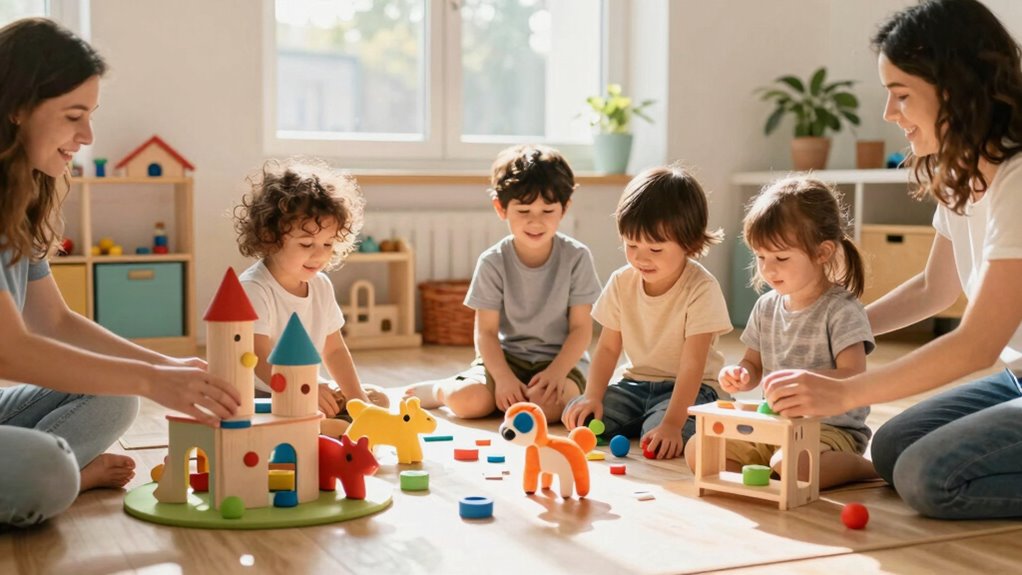
Shared pretend-play spaces offer valuable opportunities for children to develop social skills, but they also require guidance from parents to guarantee positive interactions. When children engage in pretend play together, they learn essential lessons about role boundaries—knowing what they can and cannot do within the shared scenario—and how to navigate disagreements. As a parent, your role is to help your child understand these concepts so their play remains enjoyable and constructive.
Guiding children in pretend play fosters social skills, role boundaries, and healthy conflict resolution.
One of the most important lessons you can teach is about respecting role boundaries. During pretend play, children often assume roles, like a doctor, a teacher, or a superhero. You should encourage them to stay within the limits of their roles and remind them that everyone’s input matters. If a child tries to dominate the play or overstep, gently intervene to remind them of the agreed-upon roles. This teaches children about respecting others’ space and contributions, fostering cooperation and empathy.
Conflict resolution is another key skill that naturally arises in shared pretend-play spaces. Disagreements are inevitable—perhaps two children want to be the hero, or one insists on a specific storyline. Instead of stepping in immediately to solve every conflict, guide children to resolve their differences on their own. Encourage them to express their feelings clearly, listen to each other, and find a compromise or a new storyline that satisfies everyone. This process helps them build patience, negotiation skills, and emotional regulation. When conflicts escalate or become unmanageable, your role is to step in gently, facilitate dialogue, and help them find common ground. Teaching children to resolve conflicts amicably prepares them for real-world interactions, where disagreements are part of everyday life. Recognizing social-emotional skills during these moments can further enhance their development. Moreover, fostering a sense of empathy and understanding can deepen their connection and improve their ability to cooperate. Developing emotional regulation during these moments is essential for their overall social competence. Additionally, understanding role boundaries and their importance can help children recognize the limits of their influence and respect those of others, which is crucial for healthy social development. It’s also beneficial to explain the concept of shared responsibility in play, so children understand the importance of working together toward common goals. Throughout this process, your presence and guidance are crucial. Reinforce positive behavior by praising children when they respect role boundaries or resolve conflicts peacefully. Model respectful communication yourself, demonstrating how to listen and express feelings calmly. Remember, your goal isn’t to control every aspect of the play but to create a safe environment where children learn these social skills naturally. By setting clear expectations and providing gentle guidance, you help children develop the confidence and competence they need to navigate social interactions both inside and outside shared pretend-play spaces.
In the end, teaching children about role boundaries and conflict resolution during pretend play isn’t just about making playtime fun. It’s about laying the foundation for healthy relationships, effective communication, and emotional intelligence that will benefit them throughout their lives.

Doloowee Wooden Dollhouse for Girls, Modern Doll House with 31Pcs Furniture & Accessories, DIY Pretend Play Toys with 4 Dolls Figure and 1 Puppy, Gift for Kids Ages 3+
- Immersive Role-Play Experience: Includes 31 furniture pieces and 4 dolls
- Open-Design with Multiple Rooms: Five rooms: bedroom, bathroom, study, living room, kitchen
- Durable and Sustainable Material: Made from FSC-certified sustainable wood
As an affiliate, we earn on qualifying purchases.
As an affiliate, we earn on qualifying purchases.
Frequently Asked Questions
How Can Parents Encourage Creativity in Pretend-Play?
You can encourage creativity in pretend-play by fostering imaginative collaboration and introducing role-playing techniques. Suggest different scenarios and ask your child how they’d handle them, inspiring them to think creatively. Join in their play, taking on unique roles and encouraging them to do the same. This dynamic interaction boosts their imagination, helps develop social skills, and makes shared pretend-play more engaging and inventive for everyone involved.
What Are Common Conflicts in Shared Pretend-Play Spaces?
In shared pretend-play spaces, you often face toy conflicts and fairness concerns. Kids might argue over who gets to use a toy or feel upset if they think the play is unequal. To manage this, encourage sharing, set clear rules, and teach kids to take turns. Emphasize the importance of fairness and respectful communication, helping everyone enjoy the playtime and develop social skills.
How Do Parents Set Boundaries for Pretend-Play?
You set boundaries for pretend-play by clearly communicating rules and expectations, ensuring everyone understands acceptable behaviors. Use role modeling to demonstrate respectful sharing, taking turns, and listening. Consistently reinforce boundaries through gentle reminders and positive reinforcement when children follow them. By establishing and adhering to these boundaries, you create a safe, inclusive environment that encourages creative play while teaching kids important social skills.
When Should Parents Intervene in Pretend-Play Disagreements?
You should step in during pretend-play disagreements when conflict resolution and emotional regulation are lacking. If kids start to get overly upset, aggressive, or refuse to listen, it’s time to intervene. Help them express feelings calmly and guide them toward finding a compromise. Your support teaches kids how to manage emotions and resolve conflicts constructively, making shared pretend-play spaces a positive, learning experience for everyone involved.
How Can Parents Teach Sharing During Pretend-Play Activities?
You can teach sharing during pretend-play by modeling emotional intelligence and guiding children through conflict resolution. Encourage them to express their feelings and listen to others’ perspectives. Praise cooperative behavior and suggest taking turns or sharing roles to foster fairness. Use gentle reminders and prompts to help kids recognize when they’re acting selfishly, helping them develop empathy and conflict resolution skills that make sharing easier and more natural during pretend-play.
Conclusion
Ultimately, creating shared pretend-play spaces teaches your child about cooperation and imagination. While the toys and rules set the stage, it’s your guidance that shapes their understanding of trust and respect. Just as a sandbox holds endless possibilities, your lessons nurture their social skills, blending fun with life’s deeper lessons. In these moments, the playful becomes profound, reminding you that the most important lessons often happen in the simplest, most creative spaces.